
The sisters had been estranged for years, though estranged may be too clean a word for what existed between them.
Estrangement suggests a break.
What they had was older than that.
They had grown up in the same household of willful blindness and secrets, both shaped by it, though not in equal measure.
One learned to survive by silence.
The other learned the usefulness of piety.
There had been a time, as adults, when they tried to make something resembling friendship out of biology.
A few visits. Calendar holidays. Group vacations.
The kind of gatherings that looked like family, especially in photographs.
But even then, the arrangement had its own quiet accounting.
One sister doing most of the labor and paying more than her share.
***
Years passed.
There had been an early marriage, sudden and ill-suited, the kind families approve of because it looks like “the right thing to do” from the outside.
Another child followed.
So did disappointment.
Then came a relationship no one wanted to name except as accusation.
No one asked questions.
The relationship, as mismatched as the previous one, lasted for a bit over a decade.
But when we came to be, suddenly everyone found their speaking voice.
“If you marry that woman, you need to know I’ll be no part of it.”
The woman was me.
No one had asked her to be part of anything because, by then, the fragile attempts the two sisters had made at closeness had long faded.
Still, she voiced her opposition as though she had been personally wronged.
Her hostility toward me had the heat of a jilted lover more than a sibling.
***
There were suggestions, of course. Offensive, familiar ones.
Why not go back to someone from before? Why not choose the arrangement easier to explain? Why not return to a life that had already failed, so long as it looked more acceptable from the sidewalk?
That was the strange part.
Not the disapproval. Disapproval is ordinary.
It was the possession.
That is where the distaste remains to this day.
***
As their mother’s health deteriorated, the devout sister began making decisions quietly.
Strategic decisions, presented later as unavoidable.
Their mother, who had saved money in small, stubborn ways for decades, was moved despite her wish to remain home.
Cash that had been tucked away over the years was gathered in secret and controlled.
No conversation was had with the daughter who had also been born to that mother.
Later, the money was distributed with the same hierarchy that had always existed between them.
Gold pieces went here.
Larger sums went there.
The most favored were given generous amounts and a few pieces of jewelry.
The distribution followed categories invented by one person alone.
My wife received a small money order.
Not cash pressed into her hand with tenderness.
Not a sister saying, “This is what Mom left for you.”
Not even the dignity of a face-to-face interaction.
A money order.
Worse, relatives were turned into witnesses, made to confirm that the money had been written out and sent, as though my wife were not grieving but potentially troublesome.
As though the important thing was not what she had been denied all along, but that no one could later accuse the righteous one of having denied it.
The money order was torn and discarded.
It was not the amount that stayed with us.
It was the ceremony of contempt.
Still, even that is not the moment I return to most.
The thing that remains lodged in me happened at the end.
***
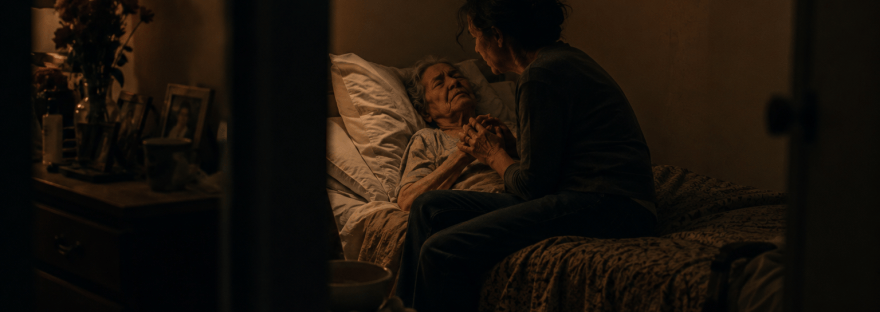
When their mother was dying, my wife was allowed into the room.
Permission granted.
Access controlled.
A daughter admitted to the final threshold of the woman who had given birth to her.
It should have been private.
Not perfect. Not sentimental.
Not the kind of scene people pretend death gives them.
But private.
A daughter beside her dying mother.
But weeks later, we learned that the moment had not been private at all.
Images had been made.
The room had been documented.
Pieces of that final intimacy had been shared beyond the room, beyond my wife’s consent, beyond ordinary decency.
I remember the sensation in my body when she told me.
Something heavier than surprise.
A suffocating disgust.
What stunned me most was not only that it had happened, but that my wife seemed accustomed to their intrusions.
I wanted to say, “Do you understand what they did?”
Not because she was naive.
Because she had been trained, for too long, to accept being managed.
Her grief had been managed.
Her inheritance had been managed.
Her access to her mother had been managed.
Even her final goodbye had been handled by other people, turned into proof, possession, preserved to maintain whatever story they needed it to serve.
And that, more than any insult directed at me, is what remains in my mind.
The intrusion.
The theft of a final moment.

