
(A Twig)
Reflections from the still places of life, where recovery and resilience meet the quiet astonishment of being here at all.
(A Twig)
I never once saw him angry.
Not really angry.
Not the way Julia got angry.
Her insults came easily, sometimes within earshot of the children, sometimes loud enough for the neighbors, and maybe even for innocent passersby who had only meant to walk down the street and got an earful.
It was always one of those he makes me lose it situations.
As if he had forced her hand.
As if his very existence had reached across the room and shaken her into cruelty.
“Look at you, you klutz. All you’re good for is writing stories about nothing. Still editing that damn book?”
That damn book was El Espejo.
When his novel piqued the interest of a movie producer, Fernando was happy. Proud, even. He told people. There had been an offer, a conversation, even a tentative new title.
Julia laughed.
“Wonder if it’s even true.”
It was true.
The film never happened. The deal fell apart somewhere, as things often do. But the offer had been real.
So was the book.
So was the man she constantly mocked.
Once, she chased him through the house with one of her heels in hand.
A heel.
Not a slipper. Not a rolling pin, which at least would have had some old comedic dignity.
A heel.
She chased him right into Mila’s bed.
Mila did what children do in ridiculous emergencies.
She pretended to be asleep.
Years later, the memory does seem rather comical from a distance: Fernando ducking, Julia storming behind him, heel raised as if it were just another prop in the tragicomedy of their lives.
Almost.
Then the afterthought arrives.
There was a child in that bed.
Julia mocked him for years. Then she came to the United States and, once here, behaved as if he had never existed.
Three years later, Fernando died.
“I am his widow now,” she said. “I’m a widow.”
The word seemed to please her.
Not the loss.
The title.
***
I never once saw him lose his temper with her. Never saw him raise a hand. Never heard him scream back. Once or twice, exasperation crossed his face, and he would quickly leave the room.
How did he manage that?
Outside the house, Julia performed the submissive wife.
Inside, she ruled with a heavy hand.
Yet Fernando remained calm.
Maybe calm was the only safe place left for him to stand.
***
As a child, Mila did not realize how grateful she would one day be that her father stayed in that house.
Because as bad as things were, they never became what they might have become had he walked away.
A terrible kind of gratitude.
Still.
Thank you, father.
They met when Julia was almost eighteen and Fernando was nearly thirty: handsome, articulate, unemployed, and overdependent on his mother.
His last name still carried a small degree of influence. Before the family moved to the capital, they had enjoyed considerable wealth through land and investments.
The entire fortune, family legend suggested, had been lost to poker tables and Cuban cigars lit with large bills.
Fernando lived with his mother and father in a large house. His mother was known to discreetly fill his pockets with cash and cigarettes.
A broker of favors by day.
Don Juan by night.
Across town, the Berkemeyer family lived in an affluent community and were known for owning several household-name brands. One of their sons, Gustavo, had also shown interest in Julia.
There are not many details about how she met either man, especially the wealthy one.
But she boasted of his pursuit for decades.
Julia’s two suitors.
Fernando and Gustavo.
One with a name still faintly perfumed by old money.
The other with money.
***
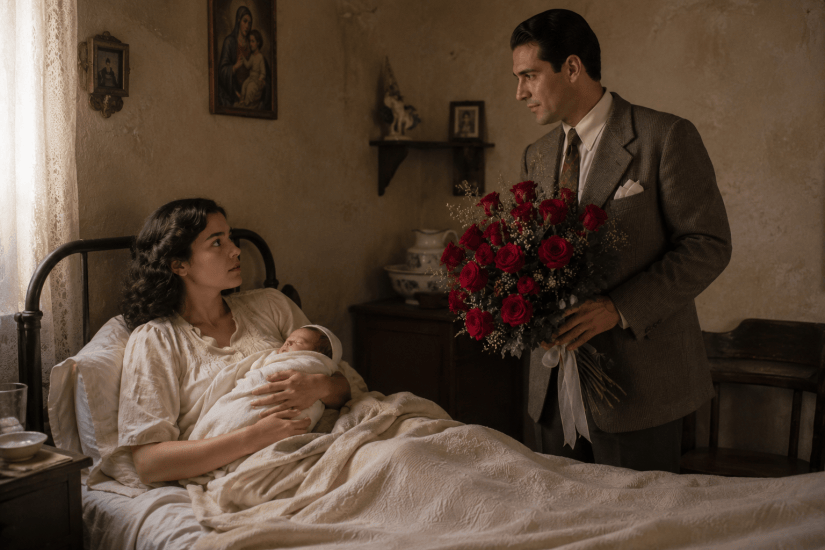
In the middle of 1949, Fernando arranged for Julia to give birth at a relative’s home in the next town over.
When the baby girl was born, Gus made his way to the remote place locals referred to as “down by the river, under the bridge,” and presented Julia with a stunning arrangement of roses.
Julia’s sister, a teenager then, remembered those roses for the rest of her life.
What Julia did during the next few years was rarely discussed. She had a baby to care for, no income, and no wish to seek support from relatives.
For a couple of years, she avoided more pregnancies.
But by the end of 1954, she had given birth to two more children.
And she was pregnant with her fourth.
***
Then Julia had a striking realization.
Leaving her three small children on Fernando’s parents’ doorstep might force the matter.
So that is exactly what she did.
She walked up to their front door, settled the children there, rang the bell, and walked away.
It worked.
Soon afterward, she was invited to stay.
His parents fled the house.
After ten years or so, they were all evicted.
***
Rumor had it Julia wanted no more children because she already had two girls and two boys.
And for the first few years of marriage, there were none.
Other than the broken mahogany chair and the marble telephone stand, the house had no furnishings.
Well, old beds.
Four children.
A house that had once belonged to someone else’s parents.
A pressured marriage.
And then, at thirty-two, Julia found herself pregnant again.
The same rumor had it she never wanted it.
Whether “it” meant the pregnancy, the child, the marriage, or the life that had closed around her, no one ever said.
The sisters had been estranged for years, though estranged may be too clean a word for what existed between them.
Estrangement suggests a break.
What they had was older than that.
They had grown up in the same household of willful blindness and secrets, both shaped by it, though not in equal measure.
One learned to survive by silence.
The other learned the usefulness of piety.
There had been a time, as adults, when they tried to make something resembling friendship out of biology.
A few visits. Calendar holidays. Group vacations.
The kind of gatherings that looked like family, especially in photographs.
But even then, the arrangement had its own quiet accounting.
One sister doing most of the labor and paying more than her share.
***
Years passed.
There had been an early marriage, sudden and ill-suited, the kind families approve of because it looks like “the right thing to do” from the outside.
Another child followed.
So did disappointment.
Then came a relationship no one wanted to name except as accusation.
No one asked questions.
The relationship, as mismatched as the previous one, lasted for a bit over a decade.
But when we came to be, suddenly everyone found their speaking voice.
“If you marry that woman, you need to know I’ll be no part of it.”
The woman was me.
No one had asked her to be part of anything because, by then, the fragile attempts the two sisters had made at closeness had long faded.
Still, she voiced her opposition as though she had been personally wronged.
Her hostility toward me had the heat of a jilted lover more than a sibling.
***
There were suggestions, of course. Offensive, familiar ones.
Why not go back to someone from before? Why not choose the arrangement easier to explain? Why not return to a life that had already failed, so long as it looked more acceptable from the sidewalk?
That was the strange part.
Not the disapproval. Disapproval is ordinary.
It was the possession.
That is where the distaste remains to this day.
***
As their mother’s health deteriorated, the devout sister began making decisions quietly.
Strategic decisions, presented later as unavoidable.
Their mother, who had saved money in small, stubborn ways for decades, was moved despite her wish to remain home.
Cash that had been tucked away over the years was gathered in secret and controlled.
No conversation was had with the daughter who had also been born to that mother.
Later, the money was distributed with the same hierarchy that had always existed between them.
Gold pieces went here.
Larger sums went there.
The most favored were given generous amounts and a few pieces of jewelry.
The distribution followed categories invented by one person alone.
My wife received a small money order.
Not cash pressed into her hand with tenderness.
Not a sister saying, “This is what Mom left for you.”
Not even the dignity of a face-to-face interaction.
A money order.
Worse, relatives were turned into witnesses, made to confirm that the money had been written out and sent, as though my wife were not grieving but potentially troublesome.
As though the important thing was not what she had been denied all along, but that no one could later accuse the righteous one of having denied it.
The money order was torn and discarded.
It was not the amount that stayed with us.
It was the ceremony of contempt.
Still, even that is not the moment I return to most.
The thing that remains lodged in me happened at the end.
***
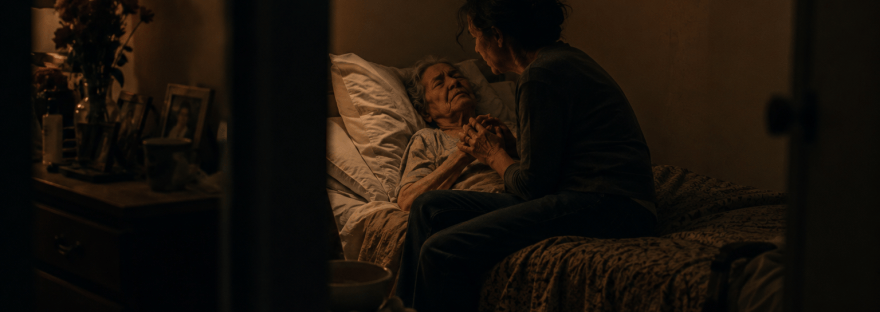
When their mother was dying, my wife was allowed into the room.
Permission granted.
Access controlled.
A daughter admitted to the final threshold of the woman who had given birth to her.
It should have been private.
Not perfect. Not sentimental.
Not the kind of scene people pretend death gives them.
But private.
A daughter beside her dying mother.
But weeks later, we learned that the moment had not been private at all.
Images had been made.
The room had been documented.
Pieces of that final intimacy had been shared beyond the room, beyond my wife’s consent, beyond ordinary decency.
I remember the sensation in my body when she told me.
Something heavier than surprise.
A suffocating disgust.
What stunned me most was not only that it had happened, but that my wife seemed accustomed to their intrusions.
I wanted to say, “Do you understand what they did?”
Not because she was naive.
Because she had been trained, for too long, to accept being managed.
Her grief had been managed.
Her inheritance had been managed.
Her access to her mother had been managed.
Even her final goodbye had been handled by other people, turned into proof, possession, preserved to maintain whatever story they needed it to serve.
And that, more than any insult directed at me, is what remains in my mind.
The intrusion.
The theft of a final moment.

At the Salaverry house, Mila was sometimes allowed to share Mercedes’s room, though Mercedes made her dissatisfaction known. She had misgivings about the child.
Rock music would blast from Mercedes’s room. Then she’d appear nonchalantly where Mila was minding her own business.
“You can come in, if you want.”
Those rare invitations into Mercedes’s private space felt almost unguarded. The Beatles played loud as she flipped through her prized collection of fan magazines.
The nostalgia of dusk brings those moments back now, their significance only recently understood.
Mercedes had an innate ability to draw women whose forms seemed almost ethereal. She would spend hours alone with all sorts of pencils, charcoal, ordinary pencils, whatever she had, always drawing women’s faces with a variety of expressions, women in flowing gowns that seemed to move, on sketch pads, notebooks.
One afternoon, right after coming home from school, Mila heard a terrifying scream followed by a terrible crashing sound.
It was the first and only time Mila ever saw Juana sob.
Julia had taken Mercedes’s entire collection of magazines and thrown them all out.
Mercedes crashed every dinner dish in the bathtub.
Of course, the story was revised afterward. Then it became that Mercedes had gone off in a rampage. The magazines, supposedly, had taken up too much space.
After that dramatic episode, Mercedes was observed rather than seen.
Mercedes and Mila were never close. There were a few years between them, and by the time Mila was placed at Salaverry, Mercedes was almost a teenager.
Still, they both existed in the same sick environment where Julia ruled, and where girls were treated as more of a nuisance than anything else.
***
Years passed. In time, Julia rented an apartment in Queens and allowed both Mercedes and Stuardo to move in with her, apparently on the premise that they would eventually split expenses with her.
Stuardo seemed absent. He began speaking of delusions. He often smoked, drank to excess, and had started acting erratically in the community.
Mila offered to take him to a local psychiatrist, chosen right out of the Yellow Pages.
“What did the doctor say?” Julia asked anxiously.
“That Stuardo has schizophrenia. He’s got to be on medication from now on.”
As dry as it sounds, that was the extent of it.
***
Jobs didn’t always come easily for Mercedes, whether factory work or part-time hours at the mall. She held on to the Alexander’s job the longest.
She became Stuardo’s caretaker.
After a few years of watching over him, Mercedes sought mental health services. What no one spoke of was the tremendous toll that sitting all day in the apartment with Stuardo had taken on her.
The story got edited to shame Mercedes for seeking help.
And wasn’t she lucky to have a place to live?
Mercedes was used by Julia as a caretaker for Stuardo for about twenty years, then discarded when she was no longer needed, just when Mercedes herself needed a hand.
Not that anyone ever admitted it.
That is how Mercedes’s whole persona disappeared into one billable psychiatric label and endless medications.
“Yeah, I told you, she’s always been weird,” Julia would comment to whoever asked.
Mila was in her own turmoil by then, descending further into addiction. In between binges, she clipped a few classified ads to encourage Mercedes to look for her own space.
“Listen, Mila, we buy The New York Times here, so don’t send me any more clippings,” Mercedes said hastily, almost offended.
And not long after came Julia’s warning:
“Stop telling her she could rent an apartment on her own. She might end up believing you!”
Two decades went by. Julia retired, got a mortgage, and moved them all into a house in Hartford.
The Apophis-approved tenants didn’t pan out. Julia grew desperate.
In short order, Julia sold the house, made a financial agreement, and moved to New Jersey.
The agreement did not include Mercedes.
Julia told her to leave.
Next thing she knew, after twenty years as an unpaid caretaker, Mercedes was on her own.
Her mental health began to spiral, yet she still managed to find services. She rented rooms at the Y. Eventually, she was referred to a subsidized housing program, which led to a studio.
A relapse led to conservatorship and, subsequently, placement in a facility.
***
Years later, Mila understood something she could not have known as a child: not being invited into Julia’s household may have saved her.
As a young woman, she had wished to belong there, or at least to be allowed to stay. But looking back at Mercedes and Stuardo, she saw the bargain more clearly.
Julia did not offer shelter.
She assigned roles.
Stuardo was protected.
Mercedes was used to protect him.
And when Mercedes herself needed protection, there was no role left for her.
The girl who drew women who seemed to float right off the paper.
Julia made sure she went nowhere.

Mila’s hiring at the Sheraton Hotel bar broadened her world.
At barely eighteen, after years under Julia’s seething wrath, Mila mistook that widening for freedom.
Maybe it was, at first.
The music. The polished glasses. The hotel guests, mostly from the United States, came and went with offers of fun and money, secrets and grief.
Mila had no idea how unprepared she was.
She soon befriended the lounge singer, Zaida, who became flirtatious first with her eyes, then with small gestures Mila did not know how to name. Secret glances turned into something neither of them dared call a romance.
It was Zaida who planted the first kiss ever on Mila’s lips, as they parted discreetly one late afternoon.
Mila had secretly wondered why her father had been so vocal against the job.
It meant nothing to Julia.
“Of course your father would say that. He doesn’t even look for steady work.”
To his credit, her father never once showed up at the Sheraton to ask Mila for even a dollar.
Apophis sure did.
It didn’t take him long to ask for a loan. Mila, who by then felt nothing but revulsion at the sight of him, turned him down.
The next day, Julia showed up with Apophis. The usual head slant. The bright red forced smile. Her hair no longer coiffed.
It worked.
Apophis never paid her back.
It didn’t take long for Mila to start dating, hanging out after work with the rest of the crew, drinking until dawn.
She knew when to push the booze aside and sip water.
She felt invincible.
Uplifted by Zaida.
Dates that lasted until the moment they both had to return to the lounge.
Discreet glances across the room.
A certain gaze that meant: this song is for you.
Mila began to imagine not leaving after all.
And if she did leave, maybe she would be the one waiting for Zaida in Miami by next year.
Then, suddenly, Zaida became ill. Hours after a dental appointment, she was rushed to the hospital.
Mila went back and forth as often as she could.
One night, it was just the two of them. Mila sat beside her on the hospital bed, close enough for their hands to find each other under the sheet.
Out of the corner of her eye, Mila caught Zaida trying to fix her hair, smiling almost sheepishly.
“Te ves linda así, natural…”
In the wee hours of a Thursday in April, Zaida managed to get out of bed. She took a few tentative steps toward the place where she was sure to find Mila.
When they embraced, Mila’s hands slid, uncertainly, to the small of her back.
The allure of intimacy.
Even if neither of them had a word for it.
Zaida was Mila’s first kiss.
Her first shared secret.
Her first moment of being wanted.
They stood locked in a silent embrace, hiding tears, desire, fear, and everything they did not yet know how to say.
As if they could disappear into each other.
Zaida died the next day.
That was one of the doors.
Not the only one.
But one of the first to close behind her.
Beer came easily, scotch followed.
Her father had told her not to take the job.
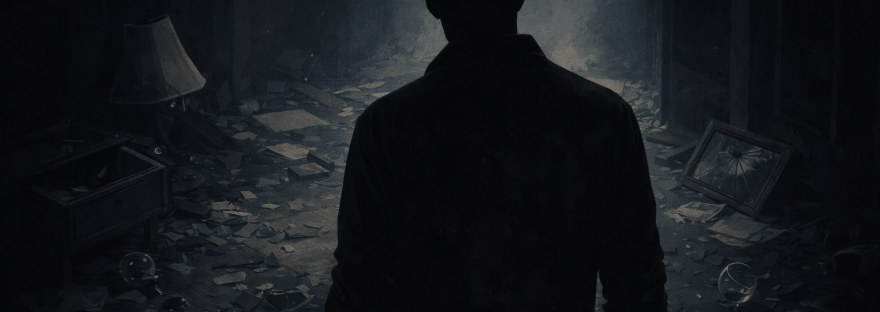
You’ve met men like him. Maybe only once. Maybe just long enough to feel the air change.
They enter rooms already convinced of their own importance, head high, chest lifted, reading every face as if the world were a mirror. Apophis was that kind of boy. He grew into the kind of man people excuse too easily and remember too late.
From early on, he worshipped one thing: himself. He mistook being male for being superior. He handed down little pronouncements as if they were law: “men wear T-shirts like this!” to girls half his size. To him, women existed mainly as proof that he was not one.
There was always something foul beneath the swagger.
Indulged for no better reason than having been born male, Apophis learned early that he could move through a room and leave no trace but the damage. He slipped through back doors, grinned through lies, stole from the very people who fed him, and treated shame as something for other people to carry.
Some of his “games” were not games at all.
He used to grab me and place me on top of his narrow frame, bouncing me up and down while he lay flat beneath me. I was too young to understand what I was feeling, only that it was wrong. Uncomfortable. Strange. I would stare at the ceiling, as if there might be something written there I was supposed to understand.
There was nothing written there.
One afternoon we heard my mother’s heels striking the parquet floor. Apophis froze, then flung me onto the other bed so fast I barely had time to register it. I landed quietly. He straightened himself. By the time she entered, nothing had happened. At least nothing that could be named.
That was his gift.
To do what he did and leave silence holding the bag.
Later he stole from his father, passed out in a room that always seemed stained by drink and neglect. He stole his mother’s cheap jewelry to impress whichever girl he was after. He took money from the same woman who defended him, spinning talk of “investment,” then shrugged when it vanished.
Years passed. Apophis married. Cheated. Married again. A daughter was born along the way, though he always seemed more interested in sons he could imagine as extensions of himself.
Now he is older, stiffer, better dressed. He stops by the rest home where his mother sits and spends more time on his phone than in her presence. He leaves before her tea cools.
Age has changed the angles of his face, but not the nature underneath.
Apophis is still Apophis.
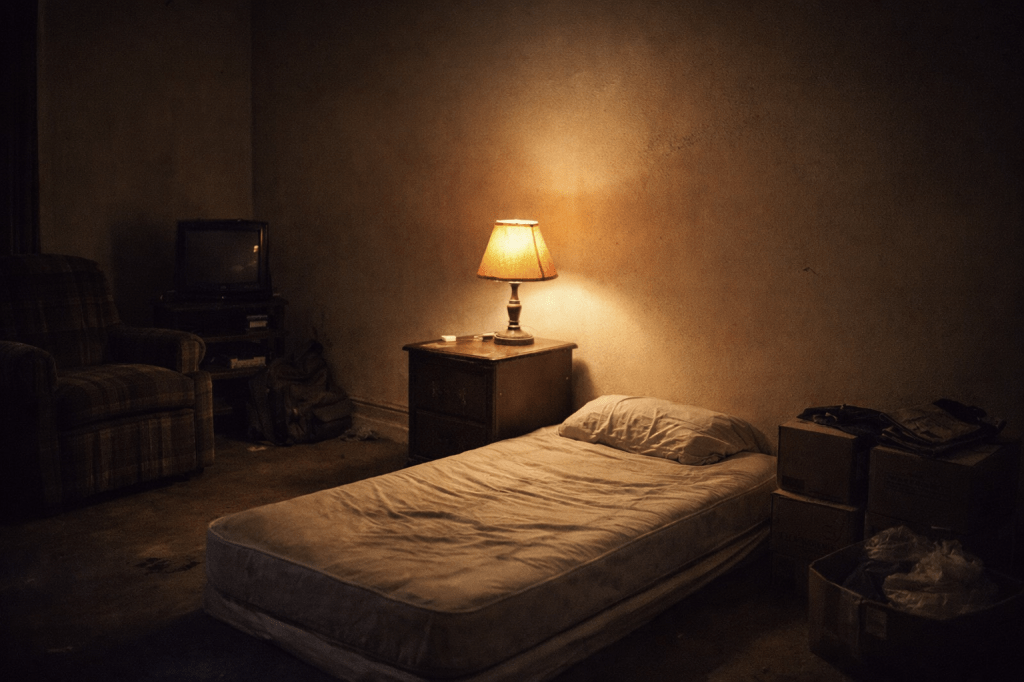
I had not been in a classroom in years. It was the fall of 1996, and there I was, bright and early for some free short term course that was supposed to lead to a job.
The crowd was exactly what I’d expected: older, unemployed Latina women. One requirement for admission was fluency in Spanish. I sat in the front beside an older woman named Miledys.
We exchanged the usual pleasantries: had either of us worked as aides before, where were we from, that sort of thing.
Then came the standard speeches about caring for people with disabilities and all the rest.
A couple of weeks later, I overheard one of the women say:
“She’s gotta speak Spanish. It’s required to get into the course.”
Miledys and I mostly kept to ourselves, swapping stories in Spanglish. Then one day at lunch, a woman called out:
“You do speak Spanish, right?”
She was talking to me.
She was heavyset, with a forceful way about her. I was drawn in by her obvious interest, her kind hazel eyes and yes, by her nice ass too. What can I tell you?
“We were just talkin’ about you in the back,” she said. “I was tellin’ them you gotta speak Spanish to be here, right?” Then she added, by way of introduction, “Regina.”
Not long after that, I got thrown out.
In a drunken stupor, I made some dramatic confession when my live-in girlfriend asked about Regina. From there, my life tipped fully into chaos.
Regina told her father about me, and he graciously agreed to let me stay with them for a while. That didn’t last.
By then I had started seeing my ex-girlfriend again, if only to spend hours snorting cocaine together. Regina saw things differently. Still angry, still hurt, she nevertheless found us a room and even bought decorations for it.
I can still see her pretty face, beaming as she said,
“It’s a start. Our first little place together.”
I am ashamed to admit I lied to her too.
A few months later, she dumped me.
One of the best things that happened to me.
After that came a couple of rooms, a couple of evictions, and then the truth stood there plain: it was down to a park bench or rehab.
I’ll never know exactly where the idea of rehab came from.
But I chose recovery.
I had been living with Manzoor for a handful of years.
Not the kind of living people imagine when they hear that. He had a place, and he had found a couple of roommates to help pay the bills. A generous if frugal man, Manzoor had never asked me to contribute a dime. He saved every penny, cooked for both of us on weekends. Meanwhile, my days were spent drinking alcohol, smoking and watching reruns on the portable black-and-white screen. Kindly put, mine was a numb existence.
“You know the electronics store on 96th and Broadway? I got a job there,” I told him.
He was getting ready to leave for a month-long trip back to his country of birth. I was annoyed by it, though I couldn’t say exactly why. I had always known he was married. That he had children there. None of it had mattered to me.
If anything, it felt oddly flattering when he told me he wanted to take me as his second wife.
At the interview, I sat across from two managers and told them, without hesitation, I was there for the assistant manager position.
Looking back, one of them must have mistaken my naivete for chutzpah. They gave me a job behind the Walkman counter.
It definitely wasn’t chutzpah.
Soon after Manzoor left, I met Joe. And Rita.
That’s when things began to tilt.
A couple of months in, Joe called me one night to declare his undying devotion, insisting he was done with Claire. As in completely done.
Claire, however, had not received that update and firmly believed she was about to become his wife. She didn’t take kindly to me moving into his apartment, just a few blocks from where I still technically lived with Manzoor.
It was wrong, but I did not even pause to question it.
Around that same time, Rita started working the register.
I remember the first time she looked at me, it was not in passing, not the way coworkers do, but with a kind of quiet insistence, like she had already decided something.
She didn’t rush it. I pretended not to notice her subtle approaches, building a kind of anticipation I hadn’t felt in years.I was flattered.
And little by little, she made her way into my days, and then into my thoughts, until there was barely a moment she didn’t occupy.
The day came when I saw Manzoor off at the airport and, as we embraced goodbye, I cried uncontrollably. I remember his face, the way he looked at me. I think he believed it meant I loved him.
As I write this now, I hope he didn’t.
Because what followed doesn’t match that kind of love.
By the time he called me, as he promised he would, I felt… nothing I could name. I spoke to him easily, kindly, but without longing. Like speaking to someone just a few doors down.
I cried when he left. I didn’t miss him when he was gone.
What unsettles me now is not that I left. It’s that I had already left before he ever boarded the plane.
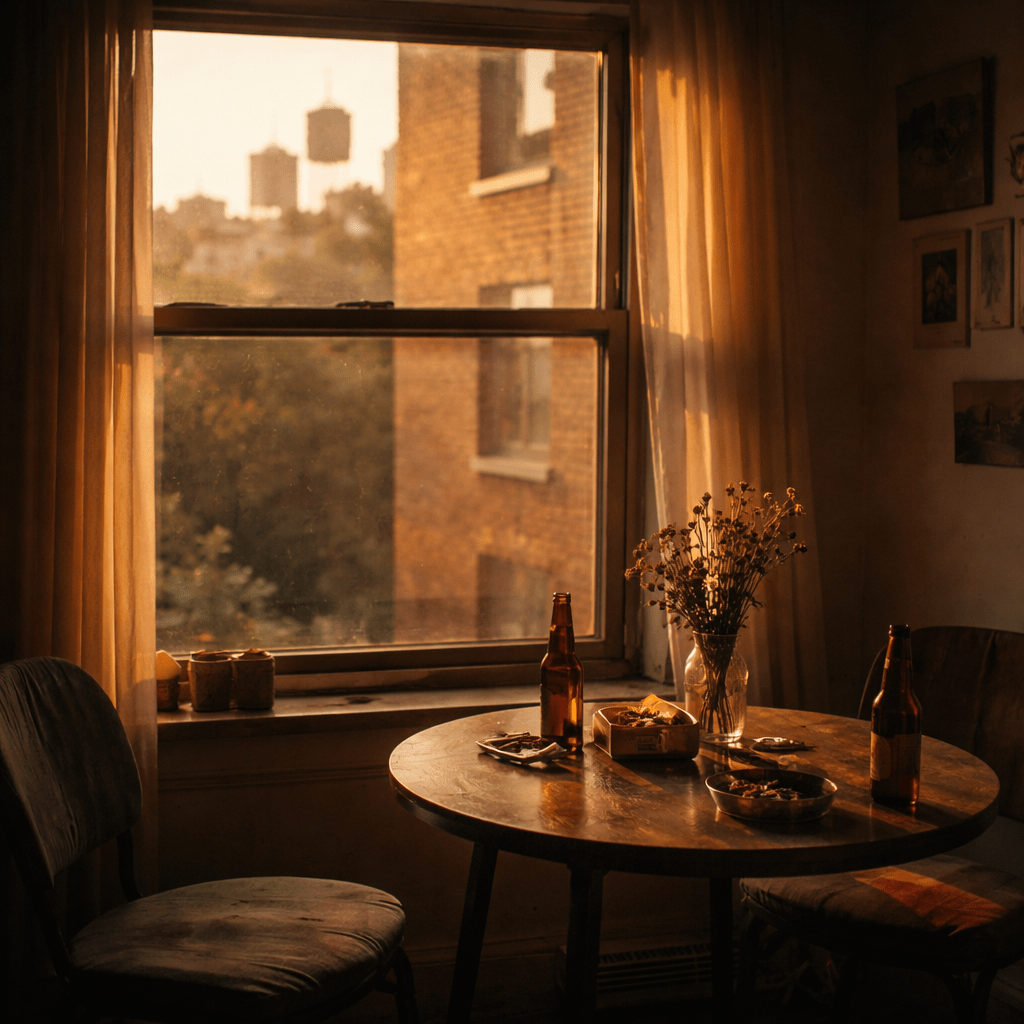
So while Manzoor was away, impulsively, I packed my few belongings, met Joe downstairs and off we went to look at hues of sunset off the brick wall out his kitchen window.
Joe, to his credit, not even once tried to force things between us; we just settled in like two old beer guzzling buddies while I fantasized of Rita’s fragrance and how it would all be like.
We found a rhythm. It didn’t last.
Rita got fired for theft and I made an ass of myself by staging a ridiculous, pompous exit, right there in front of everyone. And within minutes, there was Joe running down Broadway:
“Hey, hey, wait for mee!” as though unhinged.
What can I say, three clueless people just going about aimlessly.
Not long after, we were behind.
Claire was ecstatic.
Rita soon asked me to move into her small apartment, much to the displeasure of her teenage son whose opinion was never even asked.
We lasted ten years.
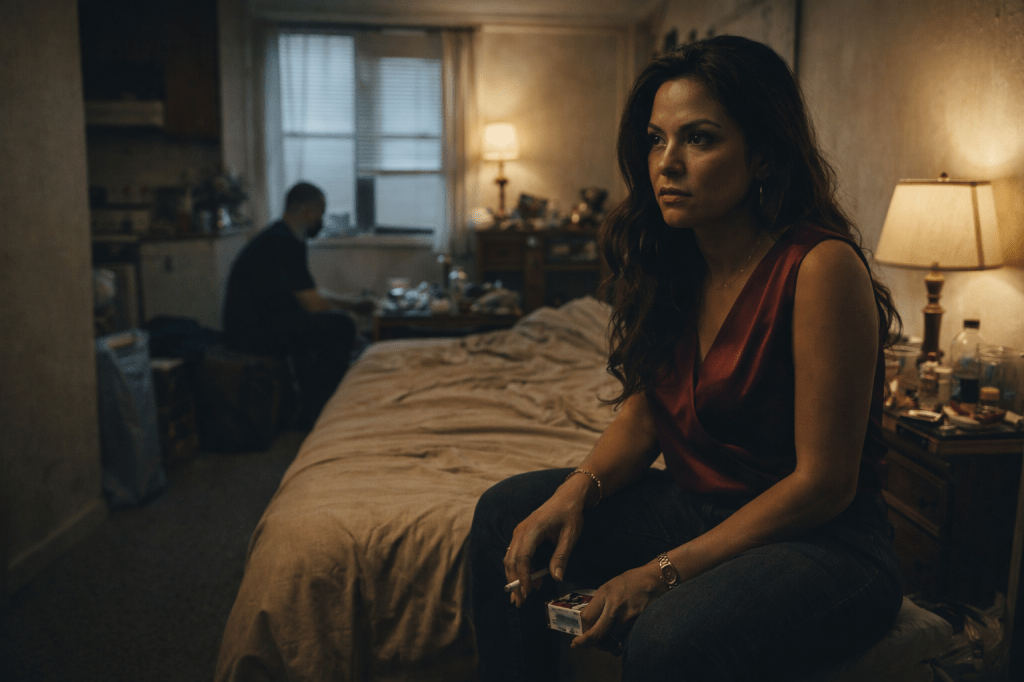
“I’ve got work with Mathew tomorrow, but we’ll get busy right after,” Rita said, smiling in anticipation.
I knew what “busy” meant.
Her gig was as an interpreter for a small legal firm, specifically for Mathew.
Mathew liked early mornings and clients before sunrise in Lower Manhattan.
The kind of cases that didn’t need to be mentioned at home.
Mathew had an overt interest in Rita, who was decades younger.
She was, at best, a tentative, often unintelligible, interpreter.
Deep in the throes of addiction, I pretended to believe the story. I regret that now.
“So… are we busy today?”
That was the code for I’m buying coke.
Ours was a daily kind of “busy,” to the exclusion of almost everything else, even whatever we once called a relationship.
Every now and then, we’d talk about looking for work, and she insisted Mathew would always be there, which made sense since he owned the building.
I convinced myself she lived there rent-free, a single mom and all…
It wasn’t free.
She paid for it in trade.
I’m not certain knowing would’ve made a difference.
Ten years went like that.
Blurred.
Wasted.
Hard to believe now.
It was a time when internet cafés and Video Professor were still a thing. Rita enrolled in free computer classes. At my suggestion, she recorded the lectures for me to transcribe.
One day she came in, animated, telling me about a job training program working with people with disabilities.
We’d been living together for almost ten years and, by then, I needed something to change.
Within days, I was sitting in a classroom.
That’s when Regina walked in.

