Aunt Vicky came to pick me up on weekends, often bringing clothes she’d made for me herself.
I lived for Saturday mornings because it meant I got to go home to my grandmother, even if only for one night.
One day, Aunt Vicky took me shopping for a scooter.
To me, this was roughly equivalent to getting my first car.
I got the ugly wooden one.
From the beginning, I mistrusted the thing.
Not that this stopped me from boasting about it. I took off on it straight toward la quinta around the block.
“You can borrow my bike, too,” some kid from the next unit called out.
I pretended not to hear him.
I rode the scooter up and down, but cautiously, mostly in front of the house and as far as an old garage up the block.
Until one day Mila felt inspired to throw caution to the wind.
She pushed off from the garage toward the house as fast as that hideous scooter would carry her, fully intending to impress any passersby fortunate enough to witness her skill.
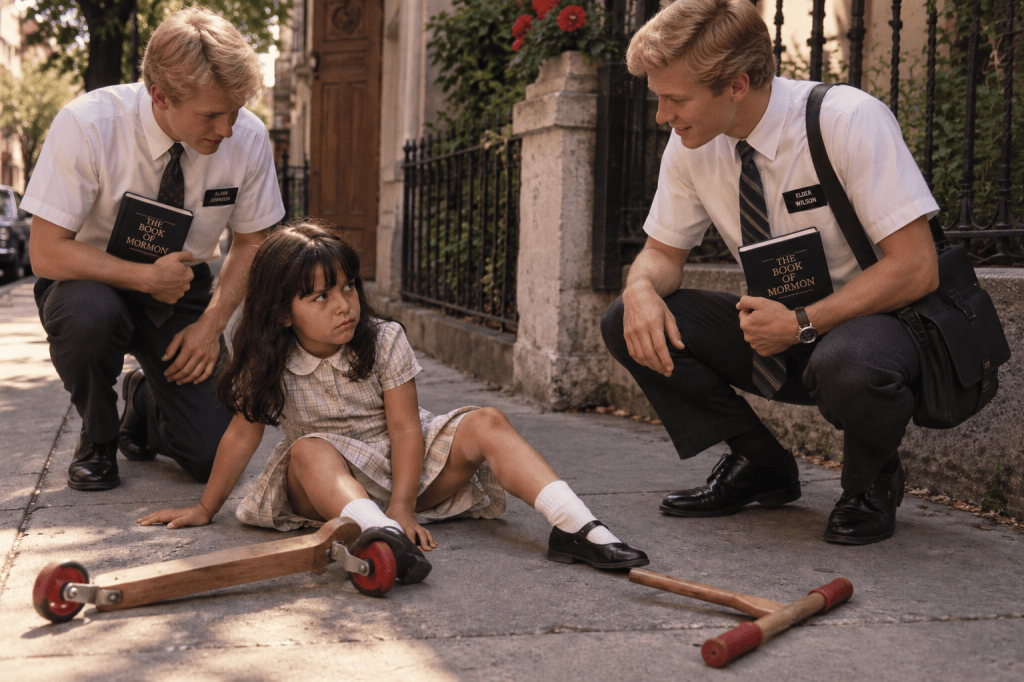
Halfway down the block, the handle came off.
Mila went one way.
The scooter went another.
I ended up on my rear end, half upside down on the sidewalk.
Two American Jehovah’s Witnesses happened to be passing.
“Are you okay? Which one is your house?”
I knew that hideous thing had it in for me.
“I’m fine. Just a scrape. My house is right there.”
I answered with what little dignity I could muster, considering they had just seen my underwear.
They walked me home.
Julia first cracked open the door, then opened it wider.
All I remember is the flowing dress, white with some red in it, and her black hair swept up into some elaborate style.
“So grateful to you for bringing her. I was just going to go get her for dinner.”
Well, at least she opened the door.
YOUR TURN
Did you ever desperately want something as a kid, only to discover it was a complete disappointment?
A bicycle, roller skates, a toy, some piece of clothing everybody else had, anything you were convinced would improve your life until reality hit.
Share your story.
Use your real name, initials, a nickname, or make one up. We’re interested in the story.
Her insults came easily, sometimes within earshot of the children, sometimes loud enough for the neighbors, and maybe even for innocent passersby who had only meant to walk down the street and got an earful.
It was always one of those he makes me lose it situations.
As if he had forced her hand.
As if his very existence had reached across the room and shaken her into cruelty.
“Look at you, you klutz. All you’re good for is writing stories about nothing. Still editing that damn book?”
That damn book was El Espejo.
When his novel piqued the interest of a movie producer, Fernando was happy. Proud, even. He told people. There had been an offer, a conversation, even a tentative new title.
Julia laughed.
“Wonder if it’s even true.”
It was true.
The film never happened. The deal fell apart somewhere, as things often do. But the offer had been real.
So was the book.
So was the man she constantly mocked.
Once, she chased him through the house with one of her heels in hand.
A heel.
Not a slipper. Not a rolling pin, which at least would have had some old comedic dignity.
A heel.
She chased him right into Mila’s bed.
Mila did what children do in ridiculous emergencies.
She pretended to be asleep.
Years later, the memory does seem rather comical from a distance: Fernando ducking, Julia storming behind him, heel raised as if it were just another prop in the tragicomedy of their lives.
Almost.
Then the afterthought arrives.
There was a child in that bed.
Julia mocked him for years. Then she came to the United States and, once here, behaved as if he had never existed.
Three years later, Fernando died.
“I am his widow now,” she said. “I’m a widow.”
The word seemed to please her.
Not the loss.
The title.
***
I never once saw him lose his temper with her. Never saw him raise a hand. Never heard him scream back. Once or twice, exasperation crossed his face, and he would quickly leave the room.
How did he manage that?
Outside the house, Julia performed the submissive wife.
Inside, she ruled with a heavy hand.
Yet Fernando remained calm.
Maybe calm was the only safe place left for him to stand.
***
As a child, Mila did not realize how grateful she would one day be that her father stayed in that house.
Because as bad as things were, they never became what they might have become had he walked away.
At the Salaverry house, Mila was sometimes allowed to share Mercedes’s room, though Mercedes made her dissatisfaction known. She had misgivings about the child.
Rock music would blast from Mercedes’s room. Then she’d appear nonchalantly where Mila was minding her own business.
“You can come in, if you want.”
Those rare invitations into Mercedes’s private space felt almost unguarded. The Beatles played loud as she flipped through her prized collection of fan magazines.
The nostalgia of dusk brings those moments back now, their significance only recently understood.
Mercedes had an innate ability to draw women whose forms seemed almost ethereal. She would spend hours alone with all sorts of pencils, charcoal, ordinary pencils, whatever she had, always drawing women’s faces with a variety of expressions, women in flowing gowns that seemed to move, on sketch pads, notebooks.
One afternoon, right after coming home from school, Mila heard a terrifying scream followed by a terrible crashing sound.
It was the first and only time Mila ever saw Juana sob.
Julia had taken Mercedes’s entire collection of magazines and thrown them all out.
Mercedes crashed every dinner dish in the bathtub.
Of course, the story was revised afterward. Then it became that Mercedes had gone off in a rampage. The magazines, supposedly, had taken up too much space.
After that dramatic episode, Mercedes was observed rather than seen.
Mercedes and Mila were never close. There were a few years between them, and by the time Mila was placed at Salaverry, Mercedes was almost a teenager.
Still, they both existed in the same sick environment where Julia ruled, and where girls were treated as more of a nuisance than anything else.
***
Years passed. In time, Julia rented an apartment in Queens and allowed both Mercedes and Stuardo to move in with her, apparently on the premise that they would eventually split expenses with her.
Stuardo seemed absent. He began speaking of delusions. He often smoked, drank to excess, and had started acting erratically in the community.
Mila offered to take him to a local psychiatrist, chosen right out of the Yellow Pages.
“What did the doctor say?” Julia asked anxiously.
“That Stuardo has schizophrenia. He’s got to be on medication from now on.”
As dry as it sounds, that was the extent of it.
***
Jobs didn’t always come easily for Mercedes, whether factory work or part-time hours at the mall. She held on to the Alexander’s job the longest.
She became Stuardo’s caretaker.
After a few years of watching over him, Mercedes sought mental health services. What no one spoke of was the tremendous toll that sitting all day in the apartment with Stuardo had taken on her.
The story got edited to shame Mercedes for seeking help.
And wasn’t she lucky to have a place to live?
Mercedes was used by Julia as a caretaker for Stuardo for about twenty years, then discarded when she was no longer needed, just when Mercedes herself needed a hand.
Not that anyone ever admitted it.
That is how Mercedes’s whole persona disappeared into one billable psychiatric label and endless medications.
“Yeah, I told you, she’s always been weird,” Julia would comment to whoever asked.
Mila was in her own turmoil by then, descending further into addiction. In between binges, she clipped a few classified ads to encourage Mercedes to look for her own space.
“Listen, Mila, we buy The New York Times here, so don’t send me any more clippings,” Mercedes said hastily, almost offended.
And not long after came Julia’s warning:
“Stop telling her she could rent an apartment on her own. She might end up believing you!”
Two decades went by. Julia retired, got a mortgage, and moved them all into a house in Hartford.
The Apophis-approved tenants didn’t pan out. Julia grew desperate.
In short order, Julia sold the house, made a financial agreement, and moved to New Jersey.
The agreement did not include Mercedes.
Julia told her to leave.
Next thing she knew, after twenty years as an unpaid caretaker, Mercedes was on her own.
Her mental health began to spiral, yet she still managed to find services. She rented rooms at the Y. Eventually, she was referred to a subsidized housing program, which led to a studio.
A relapse led to conservatorship and, subsequently, placement in a facility.
***
Years later, Mila understood something she could not have known as a child: not being invited into Julia’s household may have saved her.
As a young woman, she had wished to belong there, or at least to be allowed to stay. But looking back at Mercedes and Stuardo, she saw the bargain more clearly.
Julia did not offer shelter.
She assigned roles.
Stuardo was protected.
Mercedes was used to protect him.
And when Mercedes herself needed protection, there was no role left for her.
The girl who drew women who seemed to float right off the paper.
When Mila returned from Baltimore, she was no longer a child, though no one around her seemed prepared to notice. She saw herself as a young woman by then, worldly enough, having been to the US and back, and in her mind school was over.
“I’ll get me a job in no time, with my bilingual eloquence. Watch.”
The same aunt who had helped before helped again, feeding Mila lunch most days because food was scarce in the rented rooms. Whatever money came in came from her father’s hustling. Julia, meanwhile, spent her days dressed as if she might leave for work at any moment, in whatever fancy American clothes had survived the latest eviction.
One day, Julia became visibly agitated:
“I can’t believe he’d say that, who is this piece of shit…and why is she even talking like she herself never needed MY help, anyway?”
Vintage Julia.
Turns out her daughter in Baltimore and husband had strongly suggested her two sons, both in their early twenties, find work “someplace, anyplace, start at a gas station even.” Instead of everyone just waiting around for father to bring either money or food, seldom both.
“My sons are not going to work at a gas station, not in this town.”
One day Mila came home excited, carrying news of her first real job. What she thought she saw in Julia’s face was not pride exactly, but something close enough for the girl to mistake it for warmth.
It turned out to be a miserable commission job, the kind that paid almost nothing. Mila was still underage, and no matter how articulate or presentable she was, nobody else seemed eager to hire her.
Once that job fizzled out, Julia found herself with Mila around all day again and suddenly rediscovered her parental authority. She enrolled the girl in a nearby school.
And so it went for months, until the day Mila returned from school and found their mattress propped against the wall out front, along with everything else.
She found Julia speed walking her humiliation away.
“Good for you,” she said to Mila, “you’re taking this stoically…”
In short order, they were all trailing their father, literally walking behind him on the streets, in his search for rooms to rent.
He found one for Julia and Mila, literally on a rooftop. Two men occupied adjacent rooms. One of them enjoyed curing antlers and skulls by drying them in the sun. The other tenant was an old, puny man who had the audacity to offer marriage to Julia, offering what he thought was a hand up.
Julia felt wounded.
“How dare you,” she told him, “this is temporary for me, how dare you, I’m a married woman!”
They were soon thrown out of the rooftop room, too. And, again, it fell on her father to venture out and find rooms.
The day came when Mila spotted a want ad in a newspaper. A late night cocktail waitress job at a fancy bar in Sheraton Hotel.
Her father rarely voiced his opinion but when it came to even applying for the job, he was against her interest in it, because it was a cocktail lounge, and Mila was underage.
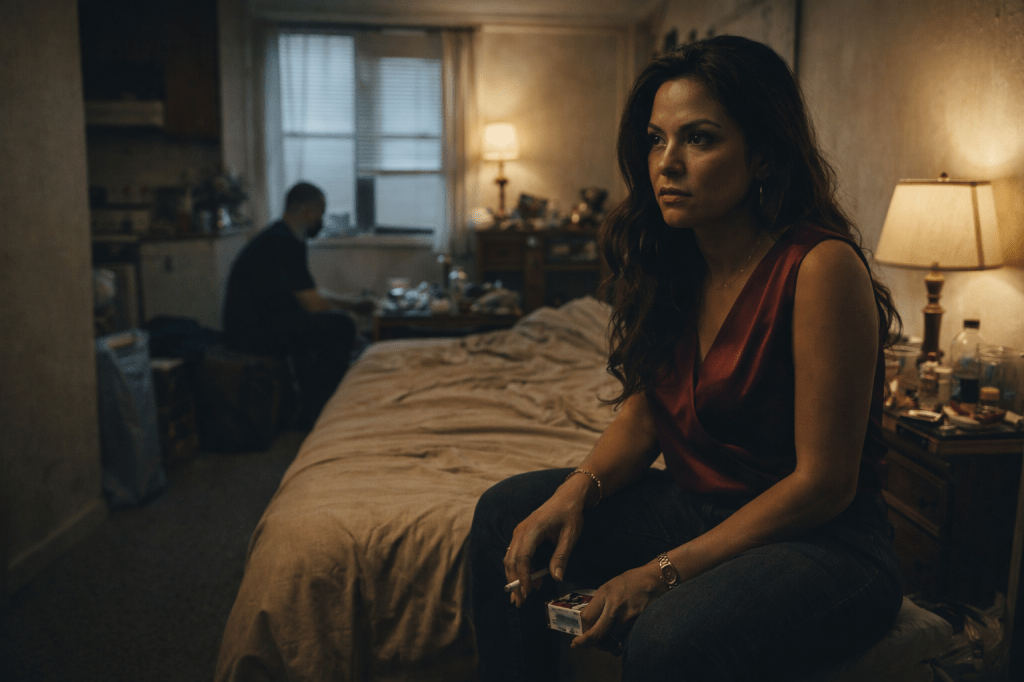
“I’ve got work with Mathew tomorrow, but we’ll get busy right after,” Rita said, smiling in anticipation.
I knew what “busy” meant.
Her gig was as an interpreter for a small legal firm, specifically for Mathew. Mathew liked early mornings and clients before sunrise in Lower Manhattan. The kind of cases that didn’t need to be mentioned at home.
Mathew had an overt interest in Rita, who was decades younger. She was, at best, a tentative, often unintelligible, interpreter.
Deep in the throes of addiction, I pretended to believe the story. I regret that now.
“So… are we busy today?”
That was the code for I’m buying coke.
Ours was a daily kind of “busy,” to the exclusion of almost everything else, even whatever we once called a relationship.
Every now and then, we’d talk about looking for work, and she insisted Mathew would always be there, which made sense since he owned the building.
I convinced myself she lived there rent-free, a single mom and all…
It wasn’t free.
She paid for it in trade.
I’m not certain knowing would’ve made a difference.
Ten years went like that. Blurred. Wasted. Hard to believe now.
It was a time when internet cafés and Video Professor were still a thing. Rita enrolled in free computer classes. At my suggestion, she recorded the lectures for me to transcribe.
One day she came in, animated, telling me about a job training program working with people with disabilities.
We’d been living together for almost ten years and, by then, I needed something to change.