Reflections

The Return

During one of Julia’s visits to her eldest in Baltimore, we got an eviction notice. Father thought it best to leave discreetly in the middle of the night.

From the marble phone stand to the broken chair to wool blankets used as luggage, things got progressively worse.

We moved into a smaller but modern house in an upscale neighborhood near the beach. Without a penny to our name. 

Then a cheap two-bedroom in a “commercial” area. It was in that building that Mila came home from school to find everything out in the hallway, the refrigerator, the only table, all of it on display for strangers to gawk at.

Julia returned, business as usual. 

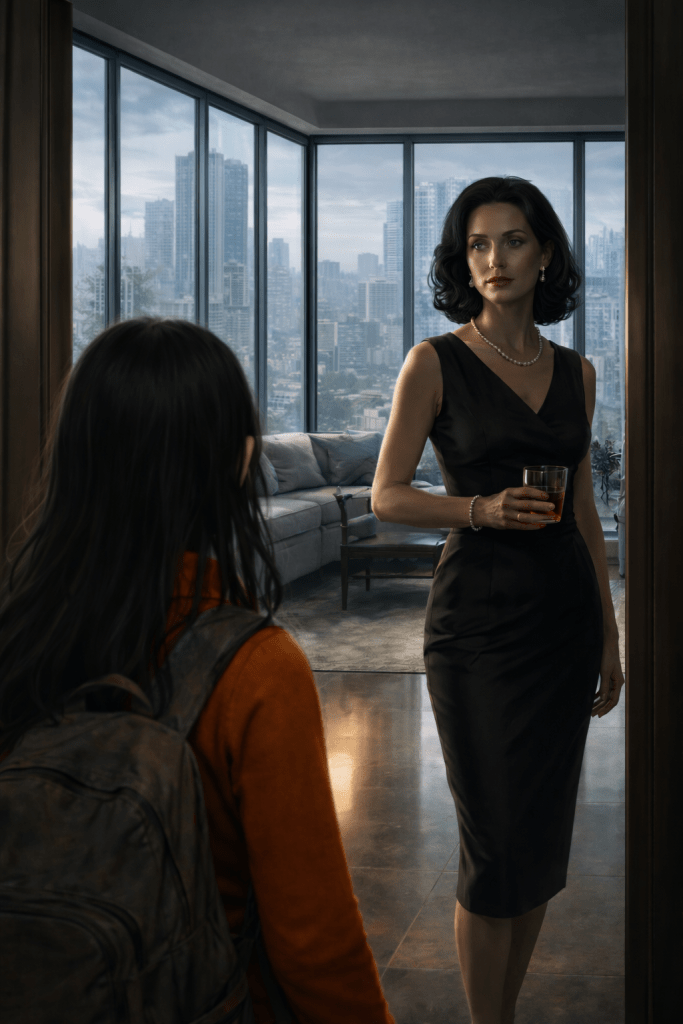
Not long after that, they moved into a large condominium in an elegant building: two units to a floor, servant’s entrance and exit, window walls.

“Just say we’re very selective about window treatments. It takes time when they’re coming from Europe…”

A glass house. You adapt.

One bright afternoon, Julia asked Mila, dryly: “And you, do you want to go to the United States?” 

Dad, sitting nearby, said nothing. 

“Yes, it’d be fine…” Mila answered nonchalantly, hiding her shock

It was, of course, her father who got the airplane tickets. Mila stayed with the older sister in Baltimore for just under two years. Julia visited at least once. On his dime. 

Some documentation error, presumably, was the reason the girl was put on the next flight back south. 

When Mila landed, no one was there waiting for her. She found a bus to a relative’s house, and from there called an aunt, who drove her to the street where she’d been told her parents and brothers lived.

“Look, my dear, I’d have to make too many turns to get to the house, you can just walk a straight line from here,” she said, pointing to a narrow, residential street. 

“They live at the end of it, on this side.”

And off the girl went, in the new orange turtleneck she’d managed to buy with babysitting money, not expecting a thing. Soon she spotted two vaguely familiar figures walking toward her along the same side of the street.

“Mila? Oh wow, it is you!” Julia offered a shallow hug, as usual, then mumbled something about a miscommunication over the flight delay.

“You’ve turned into a young woman,” said Apophis, leering at the girl’s emerging breasts. He had not changed. Julia said nothing. 

The orange mock turtleneck lingers somewhere in her mind to this day. 

There was no one to tell her the sweater had nothing to do with it. 

In the short time Mila had been away, they’d gone from the posh glass house into a series of progressively worse rented rooms. Mila found them in a corner house that had seen far better days.

It was a far cry from the days of drawn curtains.

Reflections

Apophis

You’ve met men like him. Maybe only once. Maybe just long enough to feel the air change.

They enter rooms already convinced of their own importance, head high, chest lifted, reading every face as if the world were a mirror. Apophis was that kind of boy. He grew into the kind of man people excuse too easily and remember too late.

From early on, he worshipped one thing: himself. He mistook being male for being superior. He handed down little pronouncements as if they were law: “men wear T-shirts like this!” to girls half his size. To him, women existed mainly as proof that he was not one.

There was always something foul beneath the swagger.

Indulged for no better reason than having been born male, Apophis learned early that he could move through a room and leave no trace but the damage. He slipped through back doors, grinned through lies, stole from the very people who fed him, and treated shame as something for other people to carry.

Some of his “games” were not games at all.

He used to grab me and place me on top of his narrow frame, bouncing me up and down while he lay flat beneath me. I was too young to understand what I was feeling, only that it was wrong. Uncomfortable. Strange. I would stare at the ceiling, as if there might be something written there I was supposed to understand.

There was nothing written there.

One afternoon we heard my mother’s heels striking the parquet floor. Apophis froze, then flung me onto the other bed so fast I barely had time to register it. I landed quietly. He straightened himself. By the time she entered, nothing had happened. At least nothing that could be named.

That was his gift.

To do what he did and leave silence holding the bag.

Later he stole from his father, passed out in a room that always seemed stained by drink and neglect. He stole his mother’s cheap jewelry to impress whichever girl he was after. He took money from the same woman who defended him, spinning talk of “investment,” then shrugged when it vanished.

Years passed. Apophis married. Cheated. Married again. A daughter was born along the way, though he always seemed more interested in sons he could imagine as extensions of himself.

Now he is older, stiffer, better dressed. He stops by the rest home where his mother sits and spends more time on his phone than in her presence. He leaves before her tea cools.

Age has changed the angles of his face, but not the nature underneath.

Apophis is still Apophis.

Reflections

It Wasn’t a Start

I had not been in a classroom in years. It was the fall of 1996, and there I was, bright and early for some free short term course that was supposed to lead to a job.

The crowd was exactly what I’d expected: older, unemployed Latina women. One requirement for admission was fluency in Spanish. I sat in the front beside an older woman named Miledys.

We exchanged the usual pleasantries: had either of us worked as aides before, where were we from, that sort of thing.

Then came the standard speeches about caring for people with disabilities and all the rest.

A couple of weeks later, I overheard one of the women say:

“She’s gotta speak Spanish. It’s required to get into the course.”

Miledys and I mostly kept to ourselves, swapping stories in Spanglish. Then one day at lunch, a woman called out:

“You do speak Spanish, right?”

She was talking to me.

She was heavyset, with a forceful way about her. I was drawn in by her obvious interest, her kind hazel eyes and yes, by her nice ass too. What can I tell you?

“We were just talkin’ about you in the back,” she said. “I was tellin’ them you gotta speak Spanish to be here, right?” Then she added, by way of introduction, “Regina.”

Not long after that, I got thrown out.

In a drunken stupor, I made some dramatic confession when my live-in girlfriend asked about Regina. From there, my life tipped fully into chaos.

Regina told her father about me, and he graciously agreed to let me stay with them for a while. That didn’t last.

By then I had started seeing my ex-girlfriend again, if only to spend hours snorting cocaine together. Regina saw things differently. Still angry, still hurt, she nevertheless found us a room and even bought decorations for it.

I can still see her pretty face, beaming as she said,
“It’s a start. Our first little place together.”

I am ashamed to admit I lied to her too.

A few months later, she dumped me.

One of the best things that happened to me.

After that came a couple of rooms, a couple of evictions, and then the truth stood there plain: it was down to a park bench or rehab.

I’ll never know exactly where the idea of rehab came from.

But I chose recovery.

Reflections

In Each Other’s Way

I had been living with Manzoor for a handful of years.

Not the kind of living people imagine when they hear that. He had a place, and he had found a couple of roommates to help pay the bills. A generous if frugal man, Manzoor had never asked me to contribute a dime. He saved every penny, cooked for both of us on weekends. Meanwhile, my days were spent drinking alcohol, smoking and watching reruns on the portable black-and-white screen. Kindly put, mine was a numb existence. 

“You know the electronics store on 96th and Broadway? I got a job there,” I told him.

He was getting ready to leave for a month-long trip back to his country of birth. I was annoyed by it, though I couldn’t say exactly why. I had always known he was married. That he had children there. None of it had mattered to me.

If anything, it felt oddly flattering when he told me he wanted to take me as his second wife.

At the interview, I sat across from two managers and told them, without hesitation, I was there for the assistant manager position.

Looking back, one of them must have mistaken my naivete for chutzpah. They gave me a job behind the Walkman counter.

It definitely wasn’t chutzpah.

Soon after Manzoor left, I met Joe. And Rita.

That’s when things began to tilt.

A couple of months in, Joe called me one night to declare his undying devotion, insisting he was done with Claire. As in completely done.

Claire, however, had not received that update and firmly believed she was about to become his wife. She didn’t take kindly to me moving into his apartment, just a few blocks from where I still technically lived with Manzoor.

It was wrong, but I did not even pause to question it.

Around that same time, Rita started working the register.

I remember the first time she looked at me, it was not in passing, not the way coworkers do, but with a kind of quiet insistence, like she had already decided something. 

She didn’t rush it. I pretended not to notice her subtle approaches, building a kind of anticipation I hadn’t felt in years.I was flattered. 

And little by little, she made her way into my days, and then into my thoughts, until there was barely a moment she didn’t occupy. 

The day came when I saw Manzoor off at the airport and, as we embraced goodbye, I cried uncontrollably. I remember his face, the way he looked at me. I think he believed it meant I loved him.

As I write this now, I hope he didn’t.

Because what followed doesn’t match that kind of love.

By the time he called me, as he promised he would, I felt… nothing I could name. I spoke to him easily, kindly, but without longing. Like speaking to someone just a few doors down. 

I cried when he left. I didn’t miss him when he was gone.

What unsettles me now is not that I left. It’s that I had already left before he ever boarded the plane.

So while Manzoor was away, impulsively, I packed my few belongings, met Joe downstairs and off we went to look at hues of sunset off the brick wall out his kitchen window. 

Joe, to his credit, not even once tried to force things between us; we just settled in like two old beer guzzling buddies while I fantasized of Rita’s fragrance and how it would all be like. 

We found a rhythm. It didn’t last.

Rita got fired for theft and I made an ass of myself by staging a ridiculous, pompous exit, right there in front of everyone. And within minutes, there was Joe running down Broadway: 

“Hey, hey, wait for mee!” as though unhinged.

What can I say, three clueless people just going about aimlessly. 

Not long after, we were behind.

Claire was ecstatic.

Rita soon asked me to move into her small apartment, much to the displeasure of her teenage son whose opinion was never even asked. 

We lasted ten years. 

Leaking Coconuts

Way Off

Mila was late to school again. It mortified her, having to knock on the front entrance of the director’s office. Tuition was probably late again, and old Ms. Blanco liked to send teachers into the classroom to remind her, right in front of all the other girls. Mila had learned to spot them ahead of time so she could run and hide in the bathroom.

“I’ll just say my dad dropped me off at the wrong spot. Or that the bus broke down… even better: it’s part of my new exercise regimen, and I intended to miss my stop or…”

She missed her stop by a couple blocks. Again.

She wasn’t late often, just enough to feel it. Especially after switching to the public bus at eight, no more pre-class fun with friends who rode to school on the yellow bus. 

There was that one time, though. Mila missed her stop, got off at the next one, and sat on a bench to, what else, come up with something clever to say.

That’s when a teacher from the school spotted her, scooped her up, and drove her straight to the dreaded director’s office.

“I found this girl by the shopping center, way past the park, ” Ms. Duran reported. “Imagine, had it not been for me, no telling where she’d have ended up!”

Mila had been sitting on a bench at a bus stop four blocks away. She didn’t even know where the mall was.

No one asked her a single question. Just condescending looks. She was never late after that, afraid Ms. Duran might find her again and make up something worse.

“It’d sure be easier if I could still ride the yellow bus,” Mila thought. Her parents couldn’t afford the service past first grade, so by eight or nine, the girl had no choice but to take the public bus to school. 

“Dad says we’re saving to donate more to the poor…”

Reflections

The Nitwitzes

“I want a baby,” Meera announced.
Randolph blinked. “Now? Meera, we got bills. I’m still in school, remember?”

A month later, he strode into work, grinning like he’d won the Pick 5.
“Yo, imma be a dad!”

Silence. Stares.
Then, from the back of the office:
“Uh… congrats, man,” someone mumbled, the enthusiasm flatter than a DMV clerk’s stare.

At some point, Meera called her mother to inform she’d be moving upstate for the rest of the pregnancy for “support.” That lasted five weeks, which exceeded everyone’s expectations. By mid-trimester, she was back in the Bronx.

She and Randolph headed straight to his mother’s housing project apartment, where his older brother had been scrounging off their mother for years. The guy somehow got partial custody of his kids on weekends, so the place was already bursting. Randolph—the only wage earner in the whole setup—was crashing there too. Now Meera sat like a queen on the couch, either unwilling or unable to navigate social services for assistance.

Randolph’s grin was long gone. He seemed equally unwilling or unable to grasp what was really coming.

Much could be said about how society romanticizes childbirth and motherhood. And yes, indescribable admiration goes to women who choose to become mothers. But honestly, some of what goes into the process can be flat-out traumatic. Maybe both things are true. Maybe it can be both, traumatic and beautiful.

Still, here they are, the two nitwits in over their heads and at the center of it all, a baby.

Randolph’s latest mission? Buy a couple dozen cupcakes from the bakery down the street. The kind with blue and white filling revealed when bitten into, an ultra low-budget gender reveal.

Meanwhile, Meera, still in a kind of stupor, struggles to navigate even state medical coverage, let alone housing or other basic resources.

And yet, somehow, the baby’s coming anyway.

The baby is coming.

Leaking Coconuts

Rosa H.


Some women raise children because they’re expected to. Others do it because they choose to. Rosa chose me. She wasn’t my mother by blood, but she was the one who fed me, bathed me, held me and filled our home with the scent of comfort. I never told her what she meant to me. This is my way of doing that now.


It was the early 1900s in a remote southern town. Rosa was barely a teenager when she was sent to the city to work as a maid. Presumably, her family had sent her away to support herself or perhaps she ran off; either way, no one came looking, no one ever said a word.

How Rosa survived in that new environment was never discussed. But what did happen, what changed everything, really, was that while working as a domestic servant, she became pregnant by the employers’ son, Alejandro, most likely the result of abuse. She would go on to have three more children by him. Somehow, Rosa managed to settle into a second floor walk-up and sustain a modest, stable home for herself and, eventually, six children.

I’m not sure I would’ve done any better under the same circumstances.

By the time Rosa took me in, only her youngest daughter, Virginia, remained in the apartment. Virginia doted on me too and, as a 25-year-old unmarried woman, she began to see me as her daughter.

It was both of these women who cared for me, practically from birth through the first five years of my current lifetime. Rosa was the one who did the hard parts: the diapering, the feeding, the night wakings. She didn’t hesitate. She simply took me into her home and into her heart.

She was also a good cook, nothing fancy, just nourishing, comforting food made with care. By eleven in the morning, the whole apartment would be filled with the scent of something delicious: potatoes, rice, maybe quinoa. To this day, when I think of comfort food, I think of Rosa. That smell meant love, it meant home.

The first life altering moment I can remember was the day I was taken from Rosa. No warning. No explanation, just removed and placed in the “family” home.

No one ever thanked Rosa. I didn’t either. I was too small to understand what she had given me.

This is me saying it now, mamama. You were my mother. You chose me. And I miss you.