Reflections

The Girl Who Drew Women Who Floated

At the Salaverry house, Mila was sometimes allowed to share Mercedes’s room, though Mercedes made her dissatisfaction known. She had misgivings about the child.

Rock music would blast from Mercedes’s room. Then she’d appear nonchalantly where Mila was minding her own business.

“You can come in, if you want.”

Those rare invitations into Mercedes’s private space felt almost unguarded. The Beatles played loud as she flipped through her prized collection of fan magazines.

The nostalgia of dusk brings those moments back now, their significance only recently understood.

Mercedes had an innate ability to draw women whose forms seemed almost ethereal. She would spend hours alone with all sorts of pencils, charcoal, ordinary pencils, whatever she had, always drawing women’s faces with a variety of expressions, women in flowing gowns that seemed to move, on sketch pads, notebooks.

One afternoon, right after coming home from school, Mila heard a terrifying scream followed by a terrible crashing sound.

It was the first and only time Mila ever saw Juana sob.

Julia had taken Mercedes’s entire collection of magazines and thrown them all out.

Mercedes crashed every dinner dish in the bathtub.

Of course, the story was revised afterward. Then it became that Mercedes had gone off in a rampage. The magazines, supposedly, had taken up too much space.

After that dramatic episode, Mercedes was observed rather than seen.

Mercedes and Mila were never close. There were a few years between them, and by the time Mila was placed at Salaverry, Mercedes was almost a teenager.

Still, they both existed in the same sick environment where Julia ruled, and where girls were treated as more of a nuisance than anything else.

***

Years passed. In time, Julia rented an apartment in Queens and allowed both Mercedes and Stuardo to move in with her, apparently on the premise that they would eventually split expenses with her.

Stuardo seemed absent. He began speaking of delusions. He often smoked, drank to excess, and had started acting erratically in the community.

Mila offered to take him to a local psychiatrist, chosen right out of the Yellow Pages.

“What did the doctor say?” Julia asked anxiously.

“That Stuardo has schizophrenia. He’s got to be on medication from now on.”

As dry as it sounds, that was the extent of it.

***

Jobs didn’t always come easily for Mercedes, whether factory work or part-time hours at the mall. She held on to the Alexander’s job the longest.

She became Stuardo’s caretaker.

After a few years of watching over him, Mercedes sought mental health services. What no one spoke of was the tremendous toll that sitting all day in the apartment with Stuardo had taken on her.

The story got edited to shame Mercedes for seeking help.

And wasn’t she lucky to have a place to live?

Mercedes was used by Julia as a caretaker for Stuardo for about twenty years, then discarded when she was no longer needed, just when Mercedes herself needed a hand.

Not that anyone ever admitted it.

That is how Mercedes’s whole persona disappeared into one billable psychiatric label and endless medications.

“Yeah, I told you, she’s always been weird,” Julia would comment to whoever asked.

Mila was in her own turmoil by then, descending further into addiction. In between binges, she clipped a few classified ads to encourage Mercedes to look for her own space.

“Listen, Mila, we buy The New York Times here, so don’t send me any more clippings,” Mercedes said hastily, almost offended.

And not long after came Julia’s warning:

“Stop telling her she could rent an apartment on her own. She might end up believing you!”

Two decades went by. Julia retired, got a mortgage, and moved them all into a house in Hartford.

The Apophis-approved tenants didn’t pan out. Julia grew desperate.

In short order, Julia sold the house, made a financial agreement, and moved to New Jersey.

The agreement did not include Mercedes.

Julia told her to leave.

Next thing she knew, after twenty years as an unpaid caretaker, Mercedes was on her own.

Her mental health began to spiral, yet she still managed to find services. She rented rooms at the Y. Eventually, she was referred to a subsidized housing program, which led to a studio.

A relapse led to conservatorship and, subsequently, placement in a facility.

***

Years later, Mila understood something she could not have known as a child: not being invited into Julia’s household may have saved her.

As a young woman, she had wished to belong there, or at least to be allowed to stay. But looking back at Mercedes and Stuardo, she saw the bargain more clearly.

Julia did not offer shelter.

She assigned roles.

Stuardo was protected.

Mercedes was used to protect him.

And when Mercedes herself needed protection, there was no role left for her.

The girl who drew women who seemed to float right off the paper.

Julia made sure she went nowhere.

Leaking Coconuts

Small Repairs

I dozed off early, feeling uncomfortably warm. I thought it best to lie the other way and asked my wife to turn on the fan.

I kept waking up freezing, even after she’d pulled a light cover over me. I assumed the cold air was coming from the window and said nothing.

Five a.m. rolled around and Storm demanded food. The fan was still whizzing nearby.

Just the sight of it triggered an instant rise of anger.

“You were up late. Did you not see me shivering under the covers, unable to sleep?”

I grabbed my things and slammed the door.

An interesting thing happened this time around.

I retreated to the living room, as usual. Boom. There it was.

I saw myself speed-walking to school in that short-sleeved uniform shirt, smelling like the Breck deodorant I used to roll onto my arms — the same arms that, back then, had noticeable hair, not bare skin like now.

I saw the days I pretended to wash clothes just so I could stand inside somewhere warm.

The winter days I sat unnoticed in an emergency room, figuring I could always say I was waiting for someone.

Then a pause. A whisper from within:

“You were neglected. You didn’t deserve any of that, Mila. You absolutely deserved to be cared for, as all children do.”

I wrapped that little girl in my arms and sobbed.

A little later, Iris asked, for the first time ever, calmly — not accusatory, not defensive, but as if she genuinely wanted to know:

“What’s wrong?”

“It was freezing all night. You could’ve turned the fan off. I couldn’t sleep. I froze all night.”

“But you’re the one who asked for it to be on.”

“Yes, but didn’t you even glance over and see that I was frozen under that flimsy cover? Didn’t it occur to you to check whether I was okay?”

“I am sorry,” Iris said.

No silly explanation. No deflecting. Just that again:

“I am sorry.”

Then, calmly, as she walked away:

“Are you hungry?”

It was five in the morning. And for once, what stayed with me was not the cold, but the small shock of having finally been noticed.

The Julia Series

The Return

During one of Julia’s visits to her eldest in Baltimore, we got an eviction notice. Father thought it best to leave discreetly in the middle of the night.

From the marble phone stand to the broken chair to wool blankets used as luggage, things got progressively worse.

We moved into a smaller but modern house in an upscale neighborhood near the beach. Without a penny to our name. 

Then a cheap two-bedroom in a “commercial” area. It was in that building that Mila came home from school to find everything out in the hallway, the refrigerator, the only table, all of it on display for strangers to gawk at.

Julia returned, business as usual. 

Not long after that, they moved into a large condominium in an elegant building: two units to a floor, servant’s entrance and exit, window walls.

“Just say we’re very selective about window treatments. It takes time when they’re coming from Europe…”

A glass house. You adapt.

One bright afternoon, Julia asked Mila, dryly: “And you, do you want to go to the United States?” 

Dad, sitting nearby, said nothing. 

“Yes, it’d be fine…” Mila answered nonchalantly, hiding her shock

It was, of course, her father who got the airplane tickets. Mila stayed with the older sister in Baltimore for just under two years. Julia visited at least once. On his dime. 

Some documentation error, presumably, was the reason the girl was put on the next flight back south. 

When Mila landed, no one was there waiting for her. She found a bus to a relative’s house, and from there called an aunt, who drove her to the street where she’d been told her parents and brothers lived.

“Look, my dear, I’d have to make too many turns to get to the house, you can just walk a straight line from here,” she said, pointing to a narrow, residential street. 

“They live at the end of it, on this side.”

And off the girl went, in the new orange turtleneck she’d managed to buy with babysitting money, not expecting a thing. Soon she spotted two vaguely familiar figures walking toward her along the same side of the street.

“Mila? Oh wow, it is you!” Julia offered a shallow hug, as usual, then mumbled something about a miscommunication over the flight delay.

“You’ve turned into a young woman,” said Apophis, leering at the girl’s emerging breasts. He had not changed. Julia said nothing. 

The orange mock turtleneck lingers somewhere in her mind to this day. 

There was no one to tell her the sweater had nothing to do with it. 

In the short time Mila had been away, they’d gone from the posh glass house into a series of progressively worse rented rooms. Mila found them in a corner house that had seen far better days.

It was a far cry from the days of drawn curtains.

The Julia Series

Dressed as Glamour

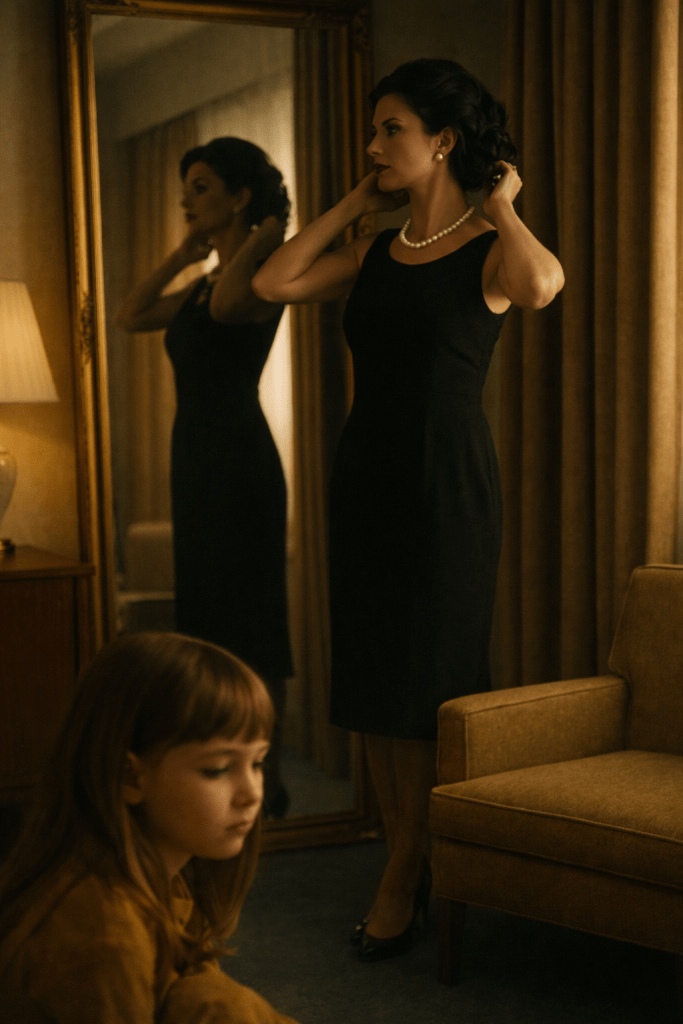
The clacking sound of high heels striking the floor still stirs something tangled in me, even if only for a second or two. I feared her. Still, I remember feeling a small, shameful pride when she dressed up, hair set just so, red lipstick, all of it in place.

She had the kind of arrogance a child could mistake for glamour.
And there was something almost amusing about it.

Clickety-clack clack…

On a good day, it preceded ice-cold silent stares.

Julia was one of Rosa’s first four children. Rosa, a young mestiza woman with little to her name, still managed to provide a home. Two more children came after that, and Julia, already ashamed of who and where she came from, hurried toward work and toward men she thought might offer a way up.

Two men seemed to offer escape. One belonged to a wealthy family. The other, Fernando, was a handsome thirty-year-old from a family whose money had faded, though its name still carried itself like royalty.

Three years later, in some remote town up north, Julia gave birth to a girl.

Gustavo came to see her soon after, carrying what her sister would remember decades later as “the largest, most beautiful roses I’d ever seen.” It made such an impression that she remembered it all those years later. Julia never mentioned it at all.

She went on to have three more babies within five years. Five years after that, another pregnancy. By then, Fernando had succumbed to her insistence and married her, much to the dismay of his parents.

For reasons never spoken aloud, Julia made sure the girl knew she had never been wanted.

Mila was Julia’s last child. When she was born, Julia had pneumonia, so Rosa took the baby home. Five years later, unexpectedly, Julia pulled the girl out of Rosa’s house and into the old one where they all lived on the bare minimum.

Other than sliced bread, margarine and canned milk, there was no food. I recall them referring to days without food as detoxification, half jokingly. 

It went on until our father either borrowed money from a friend or got food on credit. He would come in late at night, intoxicated, carrying bags of takeout.

“Wake up, Mila, come to eat…” one of the older siblings would say.

Both Julia and Dad enjoyed pretense. They sent their children to private schools even when they could not pay for things like First Communion gowns, field trips, or tuition. Three of the children eventually dropped out.

Mila was shuffled from one pretentious school to another.

We were told never to open the living room windows, lest someone notice how bare the room was: an ornate mahogany chair with half its back torn off. The front door had to be opened just so, too. The foyer held nothing but a telephone on a marble table.

“Your daughter has a beautiful voice,” one of the nuns had said of the eldest. Julia pressured her husband to come up with at least the tickets to send her to a well-known music school.

He got them airplane tickets. On credit.

They had heard it was freezing up here, so they arrived with two large bundles made of wool blankets. That was the luggage.

Julia went back and forth many times after that. On his dime. Each return announced itself the same way: heels on the floor, lipstick in place, damage entering dressed as glamour.

And to Mila, her arrivals brought both awe and dread.