The Julia Series

The Exit

Epilogue

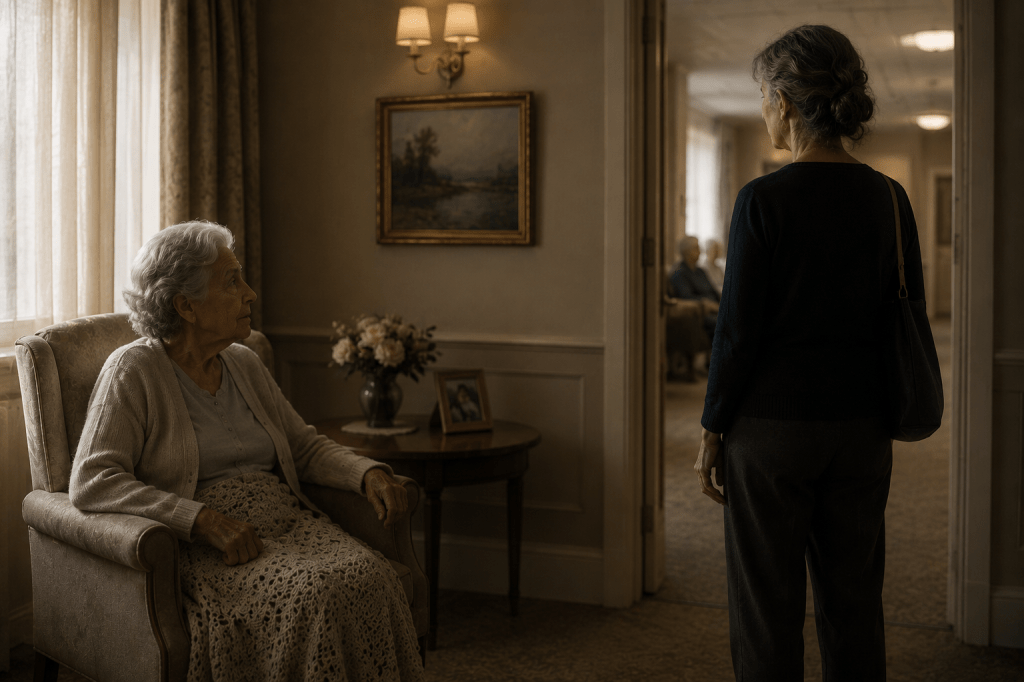
Julia sat in the nursing home room with the television on.

The sight brought back the memory of Julia watching television in her bedroom, back when HBO was advanced. How many times Mila had wished for an invitation to watch a movie from that old gray folding chair, the same one she slept on during the rare occasions she was allowed to spend the night.

The blue light from the screen washed over Julia’s face. Sundown fell across her knees and the nightstand, where a brush sat unused.

She always liked things to be looked after or, at least, to appear that way.

Mila paused at the door for a moment.

Neither to condemn nor to condone.

Not to embrace her. Not even to ask why.

Why did you have me taken away from my home?

You did not want me.

Why did you help the others, but never me?

Did you ever regret it?

No. Mila had not come for any of that.

***

Never flashy, Mila wore clean, pressed clothes. Moccasins. Clothes made well enough to last. A blazer that sat right on her shoulders. A shirt that fit just right.

She stood there in front of Julia in all of that.

Not fancy.

No pretense.

No submission.

Assembled.

Will you look into my eyes?

Julia’s expression shifted between fear and disdain.

And Mila wondered, absurdly, whether this would have pleased her.

Julia always noticed.

The gray chinos. The oversized, frayed red blouse with the tiny pocket on the left breast. The red flip-flops.

Always the red flip-flops.

“Did you notice she came in flip-flops? To my house?”

For days on end.

Her house.

As if lack of money were mud Mila had dragged into her apartment.

As if she had not known.

That one late afternoon, as they were about to settle in for an HBO movie and Mila was expected to leave, Julia got up to walk her to the front door. Quietly, she slipped a folded twenty-dollar bill into Mila’s left hand while the others sat nearby.

“Okay then, dear. Take care. Call me…”

Her face remained composed, frozen in a quarter smile, as if forced her into charity.

Mila took the money.

Of course she took it.

She needed it.

Another humiliation.

How Julia gave it.

That Mila had to take it.

For weeks, she wished she had said no.

Keep it. Keep your twenty and the little performance. Keep the satisfaction of seeing me degrade myself by taking anything from you.

But addiction has no dignity.

So she took it.

And Julia knew she would.

***

The old crime stories played on, but Julia no longer watched television. These days, it was only background noise.

Smaller now.

Not softened.

Just reduced.

There is a difference.

Her hands rested on the blanket. The same hands that had struck the face of a child for things like stealing cocoa or breaking a vase.

Mila stepped closer.

Julia glanced at her.

“Ah, I know you from somewhere. It’s these glasses…”

For that one second, Mila wanted it.

Not love. She knew better than to want love from Julia.

She wanted recognition.

Just that.

She wanted Julia to see. To know she had always been more than the child left standing outside herself. More than the young alcoholic in red flip-flops.

Mila wanted Julia to see that she had survived her.

And maybe not even that.

Julia’s eyes rested on Mila, the same lethal glare. But there was fear in it now.

Clothes.

Shoes.

Hair.

Presentation.

Maybe Julia was no longer capable of judgment. Maybe there was nothing left in her eyes but tired light.

Still, Mila felt it.

That old measuring.

And then she understood something she had not gone there to learn.

Even if Julia approved, it would not be the same as being seen by her.

Even if she looked at the attire and found nothing to criticize, even if she noticed the clean lines, the good fabric, and the woman standing upright before her, it would not be much.

It would only mean Mila had finally come to visit in a language Julia respected.

She stood there long enough to take in the moment, to let it fix itself on her. 

The television kept talking.

Someone laughed in another room.

Julia looked at her.

Maybe through her.

A confrontation would have been unfair.

There was no embrace.

Mila turned toward the door.

Behind her, the room remained exactly what it was: the television, the blanket, the fading sunlight, the woman whose focus in life had been to be admired for what she never was. The same woman who mistook coldness for refinement. The mother who never failed to notice appearances, yet never learned how to see what mattered.

At the threshold, Mila paused.

Not for Julia.

For the girl in the red flip-flops.

The one who had to take the twenty.

The one who swallowed the shame because she needed food, a way through the day.

She did not pity Julia.

Grandma Rosa came to mind.

“You come from good stock, Mila.”

***

I looked at Julia for the last time.

Then I left.

Not healed.

Not forgiven.

Gone.

Leaking Coconuts

Small Repairs

I dozed off early, feeling uncomfortably warm. I thought it best to lie the other way and asked my wife to turn on the fan.

I kept waking up freezing, even after she’d pulled a light cover over me. I assumed the cold air was coming from the window and said nothing.

Five a.m. rolled around and Storm demanded food. The fan was still whizzing nearby.

Just the sight of it triggered an instant rise of anger.

“You were up late. Did you not see me shivering under the covers, unable to sleep?”

I grabbed my things and slammed the door.

An interesting thing happened this time around.

I retreated to the living room, as usual. Boom. There it was.

I saw myself speed-walking to school in that short-sleeved uniform shirt, smelling like the Breck deodorant I used to roll onto my arms — the same arms that, back then, had noticeable hair, not bare skin like now.

I saw the days I pretended to wash clothes just so I could stand inside somewhere warm.

The winter days I sat unnoticed in an emergency room, figuring I could always say I was waiting for someone.

Then a pause. A whisper from within:

“You were neglected. You didn’t deserve any of that, Mila. You absolutely deserved to be cared for, as all children do.”

I wrapped that little girl in my arms and sobbed.

A little later, Iris asked, for the first time ever, calmly — not accusatory, not defensive, but as if she genuinely wanted to know:

“What’s wrong?”

“It was freezing all night. You could’ve turned the fan off. I couldn’t sleep. I froze all night.”

“But you’re the one who asked for it to be on.”

“Yes, but didn’t you even glance over and see that I was frozen under that flimsy cover? Didn’t it occur to you to check whether I was okay?”

“I am sorry,” Iris said.

No silly explanation. No deflecting. Just that again:

“I am sorry.”

Then, calmly, as she walked away:

“Are you hungry?”

It was five in the morning. And for once, what stayed with me was not the cold, but the small shock of having finally been noticed.

The Julia Series

The Return

During one of Julia’s visits to her eldest in Baltimore, we got an eviction notice. Father thought it best to leave discreetly in the middle of the night.

From the marble phone stand to the broken chair to wool blankets used as luggage, things got progressively worse.

We moved into a smaller but modern house in an upscale neighborhood near the beach. Without a penny to our name. 

Then a cheap two-bedroom in a “commercial” area. It was in that building that Mila came home from school to find everything out in the hallway, the refrigerator, the only table, all of it on display for strangers to gawk at.

Julia returned, business as usual. 

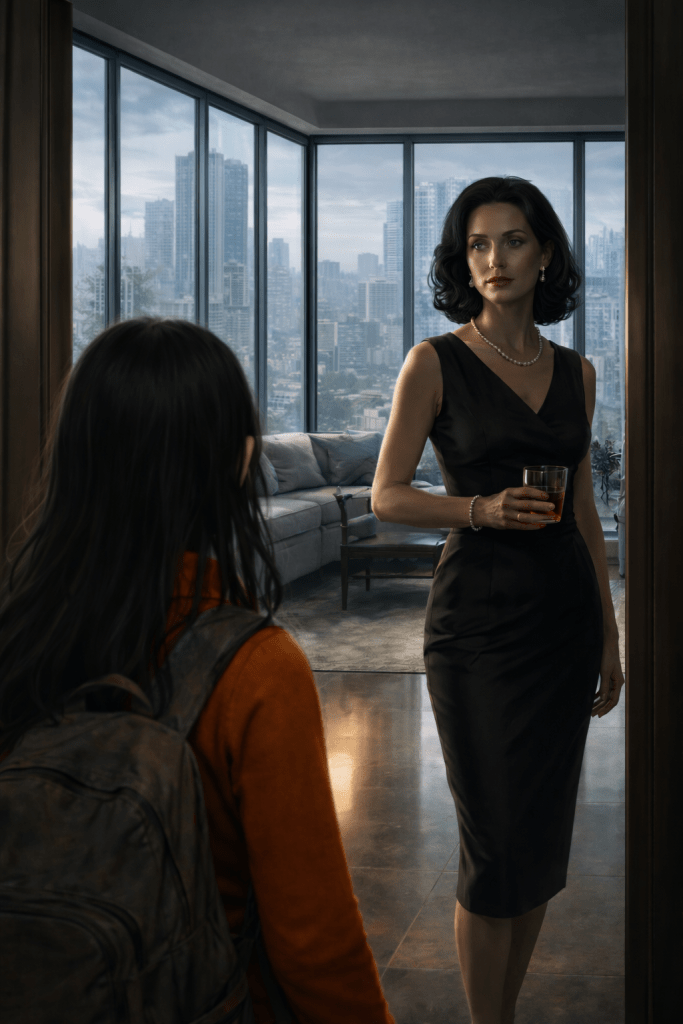
Not long after that, they moved into a large condominium in an elegant building: two units to a floor, servant’s entrance and exit, window walls.

“Just say we’re very selective about window treatments. It takes time when they’re coming from Europe…”

A glass house. You adapt.

One bright afternoon, Julia asked Mila, dryly: “And you, do you want to go to the United States?” 

Dad, sitting nearby, said nothing. 

“Yes, it’d be fine…” Mila answered nonchalantly, hiding her shock

It was, of course, her father who got the airplane tickets. Mila stayed with the older sister in Baltimore for just under two years. Julia visited at least once. On his dime. 

Some documentation error, presumably, was the reason the girl was put on the next flight back south. 

When Mila landed, no one was there waiting for her. She found a bus to a relative’s house, and from there called an aunt, who drove her to the street where she’d been told her parents and brothers lived.

“Look, my dear, I’d have to make too many turns to get to the house, you can just walk a straight line from here,” she said, pointing to a narrow, residential street. 

“They live at the end of it, on this side.”

And off the girl went, in the new orange turtleneck she’d managed to buy with babysitting money, not expecting a thing. Soon she spotted two vaguely familiar figures walking toward her along the same side of the street.

“Mila? Oh wow, it is you!” Julia offered a shallow hug, as usual, then mumbled something about a miscommunication over the flight delay.

“You’ve turned into a young woman,” said Apophis, leering at the girl’s emerging breasts. He had not changed. Julia said nothing. 

The orange mock turtleneck lingers somewhere in her mind to this day. 

There was no one to tell her the sweater had nothing to do with it. 

In the short time Mila had been away, they’d gone from the posh glass house into a series of progressively worse rented rooms. Mila found them in a corner house that had seen far better days.

It was a far cry from the days of drawn curtains.

Leaking Coconuts

Way Off

Mila was late to school again. It mortified her, having to knock on the front entrance of the director’s office. Tuition was probably late again, and old Ms. Blanco liked to send teachers into the classroom to remind her, right in front of all the other girls. Mila had learned to spot them ahead of time so she could run and hide in the bathroom.

“I’ll just say my dad dropped me off at the wrong spot. Or that the bus broke down… even better: it’s part of my new exercise regimen, and I intended to miss my stop or…”

She missed her stop by a couple blocks. Again.

She wasn’t late often, just enough to feel it. Especially after switching to the public bus at eight, no more pre-class fun with friends who rode to school on the yellow bus. 

There was that one time, though. Mila missed her stop, got off at the next one, and sat on a bench to, what else, come up with something clever to say.

That’s when a teacher from the school spotted her, scooped her up, and drove her straight to the dreaded director’s office.

“I found this girl by the shopping center, way past the park, ” Ms. Duran reported. “Imagine, had it not been for me, no telling where she’d have ended up!”

Mila had been sitting on a bench at a bus stop four blocks away. She didn’t even know where the mall was.

No one asked her a single question. Just condescending looks. She was never late after that, afraid Ms. Duran might find her again and make up something worse.

“It’d sure be easier if I could still ride the yellow bus,” Mila thought. Her parents couldn’t afford the service past first grade, so by eight or nine, the girl had no choice but to take the public bus to school. 

“Dad says we’re saving to donate more to the poor…”

Reflections

The Nitwitzes

“I want a baby,” Meera announced.
Randolph blinked. “Now? Meera, we got bills. I’m still in school, remember?”

A month later, he strode into work, grinning like he’d won the Pick 5.
“Yo, imma be a dad!”

Silence. Stares.
Then, from the back of the office:
“Uh… congrats, man,” someone mumbled, the enthusiasm flatter than a DMV clerk’s stare.

At some point, Meera called her mother to inform she’d be moving upstate for the rest of the pregnancy for “support.” That lasted five weeks, which exceeded everyone’s expectations. By mid-trimester, she was back in the Bronx.

She and Randolph headed straight to his mother’s housing project apartment, where his older brother had been scrounging off their mother for years. The guy somehow got partial custody of his kids on weekends, so the place was already bursting. Randolph—the only wage earner in the whole setup—was crashing there too. Now Meera sat like a queen on the couch, either unwilling or unable to navigate social services for assistance.

Randolph’s grin was long gone. He seemed equally unwilling or unable to grasp what was really coming.

Much could be said about how society romanticizes childbirth and motherhood. And yes, indescribable admiration goes to women who choose to become mothers. But honestly, some of what goes into the process can be flat-out traumatic. Maybe both things are true. Maybe it can be both, traumatic and beautiful.

Still, here they are, the two nitwits in over their heads and at the center of it all, a baby.

Randolph’s latest mission? Buy a couple dozen cupcakes from the bakery down the street. The kind with blue and white filling revealed when bitten into, an ultra low-budget gender reveal.

Meanwhile, Meera, still in a kind of stupor, struggles to navigate even state medical coverage, let alone housing or other basic resources.

And yet, somehow, the baby’s coming anyway.

The baby is coming.