Leaking Coconuts

Mercedes

The girl who drew ethereal women

“Well, I don’t know about that, but I can’t take sides, so let’s just leave it like that. God bless you for your help…”

Mila had recently written Mercedes a letter which included a brief mention of how abusive Apophis had always been, not only to her but also to their father and, in later years, even to Julia, his most ardent admirer.

Her voice message, not even an “I’m sorry that happened to you,” sounded as though she wanted to maintain control but couldn’t.

Her anger came across loud and clear.

And it was precisely that repressed rage that brought back recollections of odd mishaps Mercedes had claimed happened whenever Apophis was mentioned.

Recollections from when Mila was five and Mercedes was a budding, rambunctious teenager, loud at school, emboldened by Yvette, her even louder best buddy.

At some point, still at the Salaverry house, Mercedes gradually went from a good-natured, at times unruly child, to spending time alone. She drew beautiful pieces of ethereal women, faces from somewhere only she could see. She collected fan magazines and stayed in her room for hours on end.

“There she is, laying down. That’s all she knows how to do!”

Julia’s words, piercing as a razor, echo in their mind to this day.

In between evictions, the children were thrown out of the fancy schools their father had enrolled them in. Mercedes withdrew into her room, bothered by the most mundane things.

It was all attributed to her being “difficult.”

One of the lasting memories Mila has kept of Mercedes all these years is of watching Yvette help her climb onto the open back of a Jeep, the two of them laughing, full of purpose and possibility, heading off in pursuit of their grand idea to finish high school at night.

Soon after that, Yvette was never mentioned again.

Mercedes became reclusive, was allowed to drop out of high school, the drawings eventually stopped.

Apophis, just one year younger, roamed the streets late into the night, dispensing unsolicited advice pertaining to masculinity and the inferior nature of women.

This he learned from Julia, who insisted, “El hombre cae parado en todas partes.”

A man lands on his feet everywhere.

Much like a cat, which, in her mind, proved the superiority of men.

“If I had a do-over, I’d be reborn as a man and never have fucking children,” she’d say.

Often.

No exaggeration.

So while Mercedes was labeled “mental” for her social withdrawal, Apophis was admired for roaming the streets, preoccupied with his own sexual proclivities and delusions of superiority.

***

Mila had been at the Salaverry house for less than three years when, inexplicably, she made up a story about a man coming into the house at night.

A wild story.

Mila started telling Julia and the siblings that a man had begun sneaking into the house.

“He comes from the Continental Bank building, that one,” she said, pointing to a tall structure. “He talks with me. He’s nice.”

As ludicrous as the story was, the moment came when Mila was told to repeat it in front of her father, while Julia and Mercedes stood around, listening.

The girl, feeling empowered, added a couple of details to the already unlikely saga of the nightly visitor, which must have amused her father greatly.

She was well aware of her own lie.

She was also aware that through it, she was being heard and seen, if only briefly.

Her father leaned on a short wall, listening intently, while Julia looked on with disgust.

As he headed back into the house, Mercedes blurted out:

“That’s true, because some of my stuff is inside out…”

“What? What did you say?” he asked, much to Julia’s consternation and Mila’s delight.

The girl knew instantly that Mercedes’ claim was as fake as her own story of the visiting stranger.

“Yes,” Mercedes said. “I’ve had my underwear on backwards sometimes…”

Neither girl understood the implications.

Was she, too, made to play along with Apophis’ nasty bouncing “game”? Did it escalate?

No one thought her comment relevant enough to ask questions.

Mila’s story of the friendly intruder faded and was never brought up again.

***

The lack of cohesiveness and supervision made for a pattern of risk.

There was Apophis, overtly favored and sexually preoccupied. Julia, mocking instead of protecting. Mercedes, withdrawing further into herself, parents too quick to dismiss potentially disturbing claims.

No direct accusation.

Mere speculation.

Mercedes, throughout her life, was labeled as the “mentally ill” one before anyone ever asked what she might have endured. Everything she said, remembered, or protested got filed under that label.

I still wonder what happened before the label hardened around her.
The Julia Series

The Exit

Epilogue

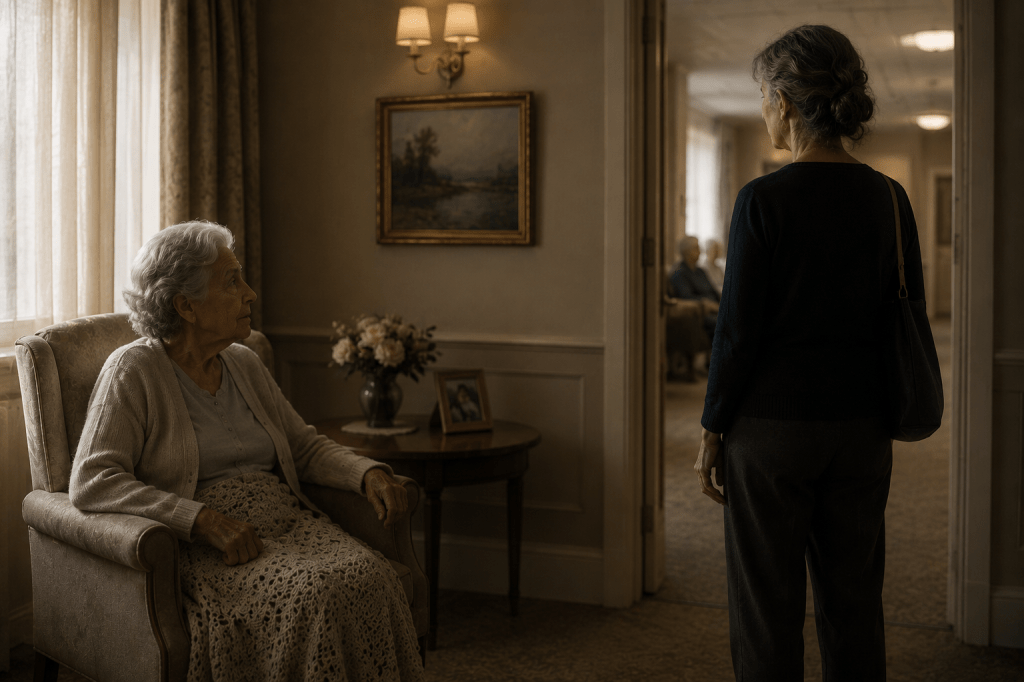
Julia sat in the nursing home room with the television on.

The sight brought back the memory of Julia watching television in her bedroom, back when HBO was advanced. How many times Mila had wished for an invitation to watch a movie from that old gray folding chair, the same one she slept on during the rare occasions she was allowed to spend the night.

The blue light from the screen washed over Julia’s face. Sundown fell across her knees and the nightstand, where a brush sat unused.

She always liked things to be looked after or, at least, to appear that way.

Mila paused at the door for a moment.

Neither to condemn nor to condone.

Not to embrace her. Not even to ask why.

Why did you have me taken away from my home?

You did not want me.

Why did you help the others, but never me?

Did you ever regret it?

No. Mila had not come for any of that.

***

Never flashy, Mila wore clean, pressed clothes. Moccasins. Clothes made well enough to last. A blazer that sat right on her shoulders. A shirt that fit just right.

She stood there in front of Julia in all of that.

Not fancy.

No pretense.

No submission.

Assembled.

Will you look into my eyes?

Julia’s expression shifted between fear and disdain.

And Mila wondered, absurdly, whether this would have pleased her.

Julia always noticed.

The gray chinos. The oversized, frayed red blouse with the tiny pocket on the left breast. The red flip-flops.

Always the red flip-flops.

“Did you notice she came in flip-flops? To my house?”

For days on end.

Her house.

As if lack of money were mud Mila had dragged into her apartment.

As if she had not known.

That one late afternoon, as they were about to settle in for an HBO movie and Mila was expected to leave, Julia got up to walk her to the front door. Quietly, she slipped a folded twenty-dollar bill into Mila’s left hand while the others sat nearby.

“Okay then, dear. Take care. Call me…”

Her face remained composed, frozen in a quarter smile, as if forced her into charity.

Mila took the money.

Of course she took it.

She needed it.

Another humiliation.

How Julia gave it.

That Mila had to take it.

For weeks, she wished she had said no.

Keep it. Keep your twenty and the little performance. Keep the satisfaction of seeing me degrade myself by taking anything from you.

But addiction has no dignity.

So she took it.

And Julia knew she would.

***

The old crime stories played on, but Julia no longer watched television. These days, it was only background noise.

Smaller now.

Not softened.

Just reduced.

There is a difference.

Her hands rested on the blanket. The same hands that had struck the face of a child for things like stealing cocoa or breaking a vase.

Mila stepped closer.

Julia glanced at her.

“Ah, I know you from somewhere. It’s these glasses…”

For that one second, Mila wanted it.

Not love. She knew better than to want love from Julia.

She wanted recognition.

Just that.

She wanted Julia to see. To know she had always been more than the child left standing outside herself. More than the young alcoholic in red flip-flops.

Mila wanted Julia to see that she had survived her.

And maybe not even that.

Julia’s eyes rested on Mila, the same lethal glare. But there was fear in it now.

Clothes.

Shoes.

Hair.

Presentation.

Maybe Julia was no longer capable of judgment. Maybe there was nothing left in her eyes but tired light.

Still, Mila felt it.

That old measuring.

And then she understood something she had not gone there to learn.

Even if Julia approved, it would not be the same as being seen by her.

Even if she looked at the attire and found nothing to criticize, even if she noticed the clean lines, the good fabric, and the woman standing upright before her, it would not be much.

It would only mean Mila had finally come to visit in a language Julia respected.

She stood there long enough to take in the moment, to let it fix itself on her. 

The television kept talking.

Someone laughed in another room.

Julia looked at her.

Maybe through her.

A confrontation would have been unfair.

There was no embrace.

Mila turned toward the door.

Behind her, the room remained exactly what it was: the television, the blanket, the fading sunlight, the woman whose focus in life had been to be admired for what she never was. The same woman who mistook coldness for refinement. The mother who never failed to notice appearances, yet never learned how to see what mattered.

At the threshold, Mila paused.

Not for Julia.

For the girl in the red flip-flops.

The one who had to take the twenty.

The one who swallowed the shame because she needed food, a way through the day.

She did not pity Julia.

Grandma Rosa came to mind.

“You come from good stock, Mila.”

***

I looked at Julia for the last time.

Then I left.

Not healed.

Not forgiven.

Gone.

The Julia Series

What Followed Her Out

Years have passed. The specter of Julia is buried, yet remains.

Mila didn’t know her. No one did.

She knew her arrogance. Her indifference.

Was Julia aware of who first opened that wound?

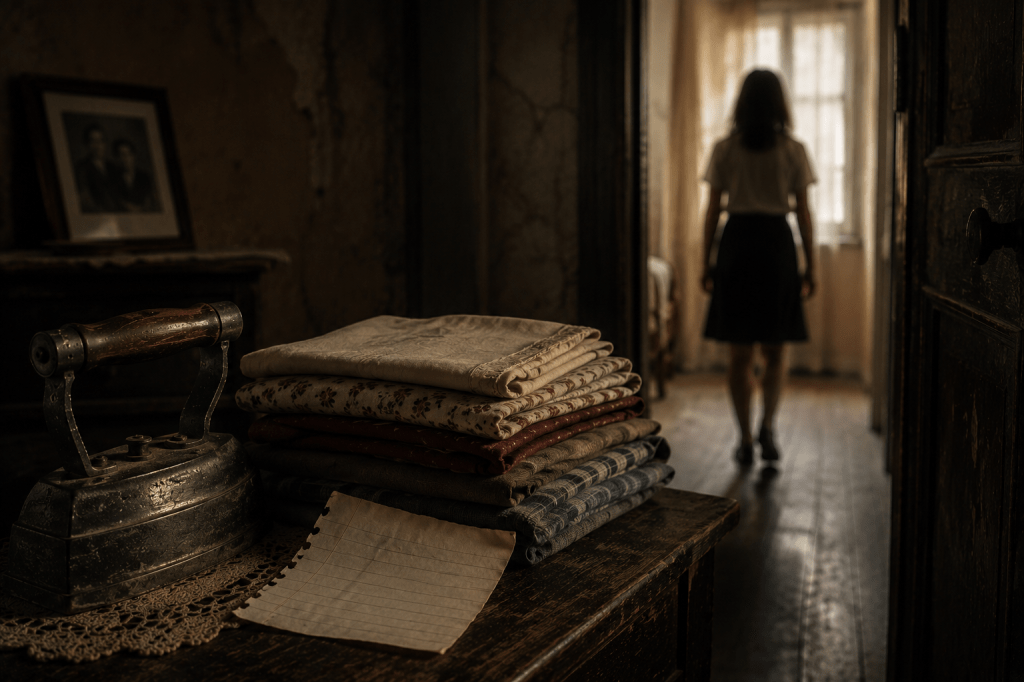
Her father’s wife ran a clothes-washing business and made Julia iron for hours on end while her father said nothing.

The stepmother had a teenage son who could do no wrong.

Young Julia could do no right.

“Baja la cabeza, mierda,” she would say, pulling the girl’s hair to avoid her stare.

That was life for young Julia: in and out of public school, back and forth between her parents, ashamed of her own social class.

Mila never knew what happened in that house.

She only knew what followed her out of it.

***

The first time Mila showed Julia a little piece she had written, they were on a city bus, of all places. Mila was in her early teens.

She had thought about it for days, whether to show it to her or not, then dared herself to do it right there.

“What’s this?” Julia said, unfolding the small piece of paper.

“Chip off the old block. Just like her father,” she said, laughing uproariously as she looked at it.

Mila smiled as if that had been the joke all along, folded the paper, and tucked it away.

Yes, Julia had once been a girl forced to lower her head and suffer indignities.

And no one came for her.

Maybe that was where the wound began.

She regretted having children, let alone motherhood.

No reproach there.

But it was still her choice to pass humiliation down to the last child she birthed.

No absolution.

Old age doesn’t exonerate her any more than sobriety exempts addicts from the harm they caused.

At dusk, Mila wonders if, in the recess of what is left of Julia’s mind, she remembers.

Hope not.