Leaking Coconuts

Rooms to Rent

When Mila returned from Baltimore, she was no longer a child, though no one around her seemed prepared to notice. She saw herself as a young woman by then, worldly enough, having been to the US and back, and in her mind school was over.

“I’ll get me a job in no time, with my bilingual eloquence. Watch.”

The same aunt who had helped before helped again, feeding Mila lunch most days because food was scarce in the rented rooms. Whatever money came in came from her father’s hustling. Julia, meanwhile, spent her days dressed as if she might leave for work at any moment, in whatever fancy American clothes had survived the latest eviction.

One day, Julia became visibly agitated: 

“I can’t believe he’d say that, who is this piece of shit…and why is she even talking like she herself never needed MY help, anyway?” 

Vintage Julia.

Turns out her daughter in Baltimore and husband had strongly suggested her two sons, both in their early twenties, find work “someplace, anyplace, start at a gas station even.” Instead of everyone just waiting around for father to bring either money or food, seldom both. 

“My sons are not going to work at a gas station, not in this town.” 

One day Mila came home excited, carrying news of her first real job. What she thought she saw in Julia’s face was not pride exactly, but something close enough for the girl to mistake it for warmth.

It turned out to be a miserable commission job, the kind that paid almost nothing. Mila was still underage, and no matter how articulate or presentable she was, nobody else seemed eager to hire her. 

Once that job fizzled out, Julia found herself with Mila around all day again and suddenly rediscovered her parental authority. She enrolled the girl in a nearby school.

And so it went for months, until the day Mila returned from school and found their mattress propped against the wall out front, along with everything else. 

She found Julia speed walking her humiliation away. 

“Good for you,” she said to Mila, “you’re taking this stoically…” 

In short order, they were all trailing their father, literally walking behind him on the streets, in his search for rooms to rent. 

He found one for Julia and Mila, literally on a rooftop. Two men occupied adjacent rooms. One of them enjoyed curing antlers and skulls by drying them in the sun. The other tenant was an old, puny man who had the audacity to offer marriage to Julia, offering what he thought was a hand up. 

Julia felt wounded. 

“How dare you,” she told him, “this is temporary for me, how dare you, I’m a married woman!”

They were soon thrown out of the rooftop room, too. And, again, it fell on her father to venture out and find rooms. 


The day came when Mila spotted a want ad in a newspaper. A late night cocktail waitress job at a fancy bar in Sheraton Hotel. 

Her father rarely voiced his opinion but when it came to even applying for the job, he was against her interest in it, because it was a cocktail lounge, and Mila was underage.

Julia didn’t seem to care one way or the other. 

Mila got the 6 p.m. to 2 a.m. shift.

From that point forward, her trajectory changed.

Reflections

Dressed as Glamour

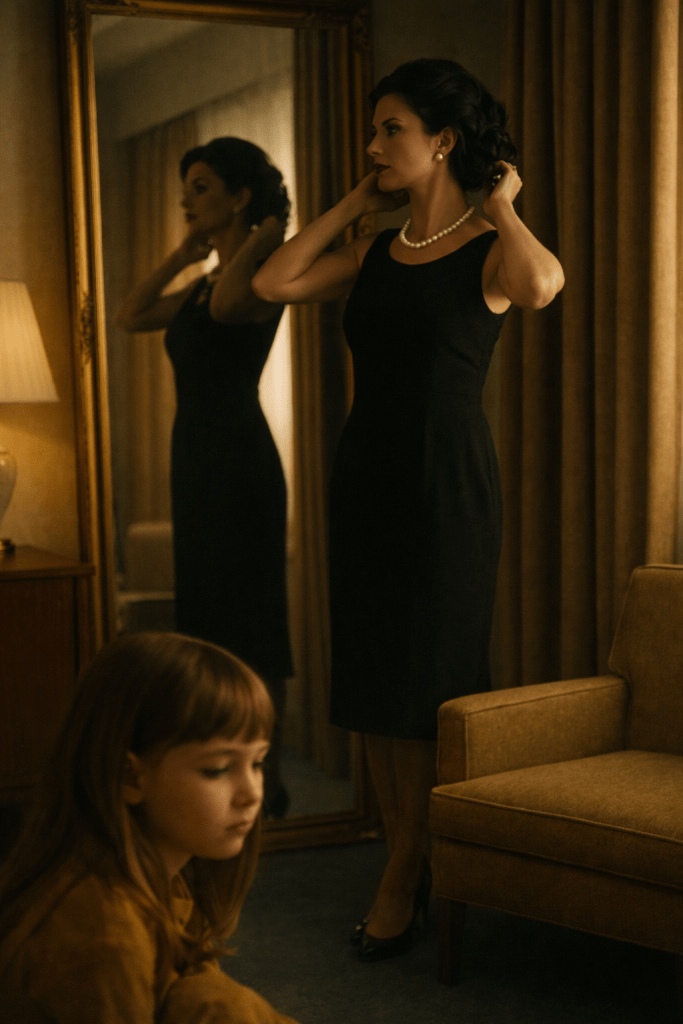
The clacking sound of high heels striking the floor still stirs something tangled in me, even if only for a second or two. I feared her. Still, I remember feeling a small, shameful pride when she dressed up, hair set just so, red lipstick, all of it in place.

She had the kind of arrogance a child could mistake for glamour.
And there was something almost amusing about it.

Clickety-clack clack…

On a good day, it preceded ice-cold silent stares.

Julia was one of Rosa’s first four children. Rosa, a young mestiza woman with little to her name, still managed to provide a home. Two more children came after that, and Julia, already ashamed of who and where she came from, hurried toward work and toward men she thought might offer a way up.

Two men seemed to offer escape. One belonged to a wealthy family. The other, Fernando, was a handsome thirty-year-old from a family whose money had faded, though its name still carried itself like royalty.

Three years later, in some remote town up north, Julia gave birth to a girl.

Gustavo came to see her soon after, carrying what her sister would remember decades later as “the largest, most beautiful roses I’d ever seen.” It made such an impression that she remembered it all those years later. Julia never mentioned it at all.

She went on to have three more babies within five years. Five years after that, another pregnancy. By then, Fernando had succumbed to her insistence and married her, much to the dismay of his parents.

For reasons never spoken aloud, Julia made sure the girl knew she had never been wanted.

Mila was Julia’s last child. When she was born, Julia had pneumonia, so Rosa took the baby home. Five years later, unexpectedly, Julia pulled the girl out of Rosa’s house and into the old one where they all lived on the bare minimum.

Other than sliced bread, margarine and canned milk, there was no food. I recall them referring to days without food as detoxification, half jokingly. 

It went on until our father either borrowed money from a friend or got food on credit. He would come in late at night, intoxicated, carrying bags of takeout.

“Wake up, Mila, come to eat…” one of the older siblings would say.

Both Julia and Dad enjoyed pretense. They sent their children to private schools even when they could not pay for things like First Communion gowns, field trips, or tuition. Three of the children eventually dropped out.

Mila was shuffled from one pretentious school to another.

We were told never to open the living room windows, lest someone notice how bare the room was: an ornate mahogany chair with half its back torn off. The front door had to be opened just so, too. The foyer held nothing but a telephone on a marble table.

“Your daughter has a beautiful voice,” one of the nuns had said of the eldest. Julia pressured her husband to come up with at least the tickets to send her to a well-known music school.

He got them airplane tickets. On credit.

They had heard it was freezing up here, so they arrived with two large bundles made of wool blankets. That was the luggage.

Julia went back and forth many times after that. On his dime. Each return announced itself the same way: heels on the floor, lipstick in place, damage entering dressed as glamour.

And to Mila, her arrivals brought both awe and dread.

Reflections

In Each Other’s Way

I had been living with Manzoor for a handful of years.

Not the kind of living people imagine when they hear that. He had a place, and he had found a couple of roommates to help pay the bills. A generous if frugal man, Manzoor had never asked me to contribute a dime. He saved every penny, cooked for both of us on weekends. Meanwhile, my days were spent drinking alcohol, smoking and watching reruns on the portable black-and-white screen. Kindly put, mine was a numb existence. 

“You know the electronics store on 96th and Broadway? I got a job there,” I told him.

He was getting ready to leave for a month-long trip back to his country of birth. I was annoyed by it, though I couldn’t say exactly why. I had always known he was married. That he had children there. None of it had mattered to me.

If anything, it felt oddly flattering when he told me he wanted to take me as his second wife.

At the interview, I sat across from two managers and told them, without hesitation, I was there for the assistant manager position.

Looking back, one of them must have mistaken my naivete for chutzpah. They gave me a job behind the Walkman counter.

It definitely wasn’t chutzpah.

Soon after Manzoor left, I met Joe. And Rita.

That’s when things began to tilt.

A couple of months in, Joe called me one night to declare his undying devotion, insisting he was done with Claire. As in completely done.

Claire, however, had not received that update and firmly believed she was about to become his wife. She didn’t take kindly to me moving into his apartment, just a few blocks from where I still technically lived with Manzoor.

It was wrong, but I did not even pause to question it.

Around that same time, Rita started working the register.

I remember the first time she looked at me, it was not in passing, not the way coworkers do, but with a kind of quiet insistence, like she had already decided something. 

She didn’t rush it. I pretended not to notice her subtle approaches, building a kind of anticipation I hadn’t felt in years.I was flattered. 

And little by little, she made her way into my days, and then into my thoughts, until there was barely a moment she didn’t occupy. 

The day came when I saw Manzoor off at the airport and, as we embraced goodbye, I cried uncontrollably. I remember his face, the way he looked at me. I think he believed it meant I loved him.

As I write this now, I hope he didn’t.

Because what followed doesn’t match that kind of love.

By the time he called me, as he promised he would, I felt… nothing I could name. I spoke to him easily, kindly, but without longing. Like speaking to someone just a few doors down. 

I cried when he left. I didn’t miss him when he was gone.

What unsettles me now is not that I left. It’s that I had already left before he ever boarded the plane.

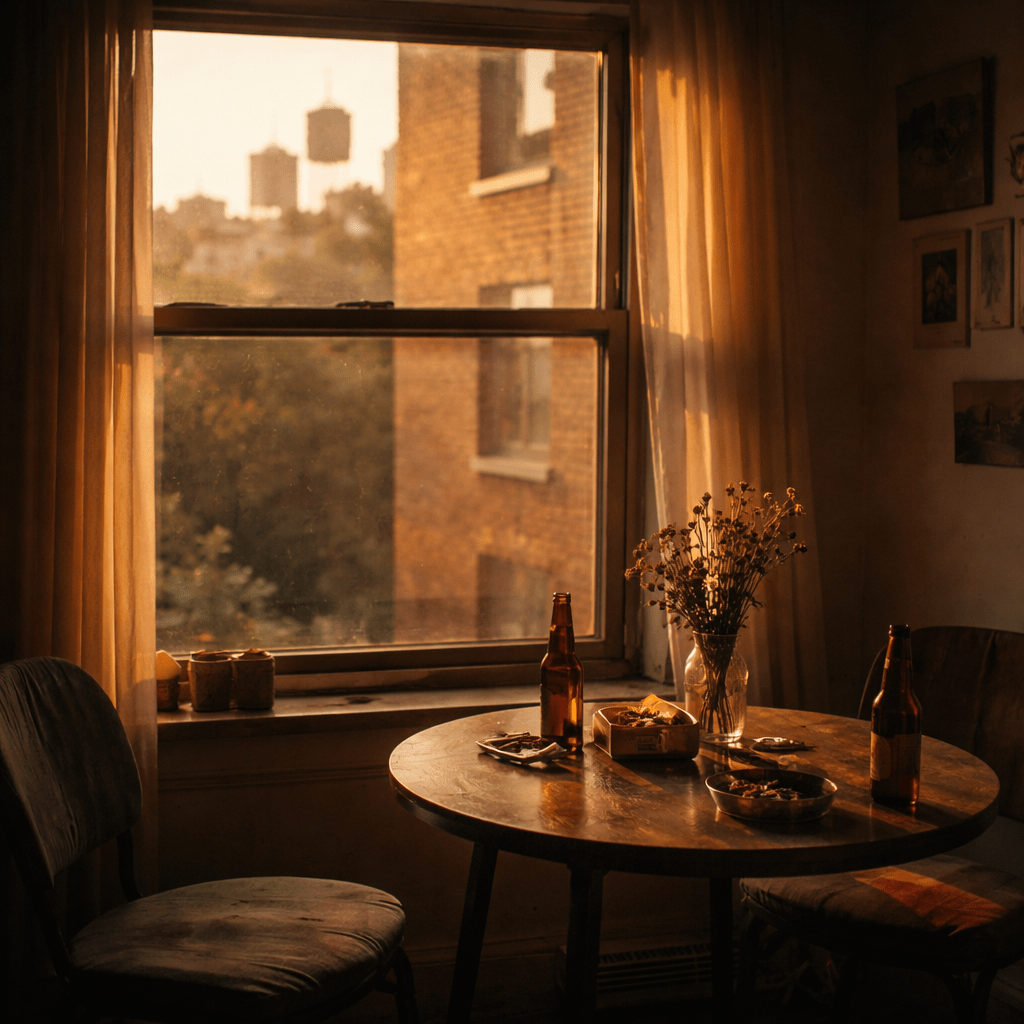
So while Manzoor was away, impulsively, I packed my few belongings, met Joe downstairs and off we went to look at hues of sunset off the brick wall out his kitchen window. 

Joe, to his credit, not even once tried to force things between us; we just settled in like two old beer guzzling buddies while I fantasized of Rita’s fragrance and how it would all be like. 

We found a rhythm. It didn’t last.

Rita got fired for theft and I made an ass of myself by staging a ridiculous, pompous exit, right there in front of everyone. And within minutes, there was Joe running down Broadway: 

“Hey, hey, wait for mee!” as though unhinged.

What can I say, three clueless people just going about aimlessly. 

Not long after, we were behind.

Claire was ecstatic.

Rita soon asked me to move into her small apartment, much to the displeasure of her teenage son whose opinion was never even asked. 

We lasted ten years.