
We lived in two rented rooms at 750 Porta, in swanky Miraflores, not far from the beach.
An address that sounded a lot nicer than our actual living arrangements.
Father had rented one room for himself and my two brothers, Estuardo and Apophis. It had a blue door that opened directly onto the street, a window through which stray cats came and went, and three narrow single beds.
Julia had a smaller room to herself.
At least until I came along.
I’d returned to Lima because of some documentation issue I can no longer remember, and my arrival meant that Julia had to share her little room with me.
There was a mattress, a small table, a folding chair, and a window. That was about it. During the day, we propped the mattress against the wall.
I spent most of my time there, doing homework or peeking through the window to see what Cucha was up to and perhaps catch a little chisme.
Cucha lived in a little room off the patio with her sons, Carlitos and Eduardo. Across the street lived a short, heavyset woman with at least thirteen children.
Julia wasn’t particularly interested in spending time with me. She preferred to sit in Father’s room, especially since he was usually out.
At some point, she insisted I enroll in school.
I was about sixteen, had been living abroad, was bilingual and, in my view, mature enough to be an adult. Going back to school would’ve been an embarrassment.
Perhaps Julia genuinely thought it was best for me.
Or perhaps she’d discovered a convenient way to have her little room to herself for several hours every day.
I wouldn’t put it past her.
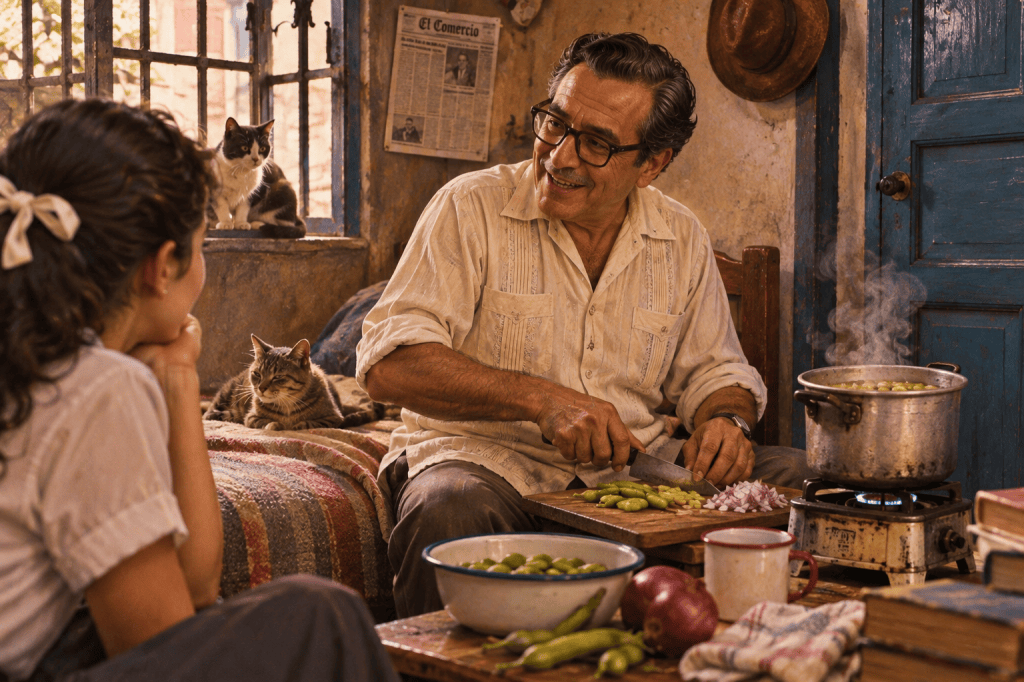
I often spent time in Father’s room, particularly when he cooked.
There was a portable burner, which he used to prepare whatever Julia had managed to purchase with the money available.
The man could cook.
He’d wash up, then sit on one of the beds with a cheap cutting board and begin chopping vegetables. Depending on how much money was available, he’d make fava beans, black beans, sometimes adding inexpensive cuts of meat.
And rice. He made the most delicious plain white rice.
I liked sitting nearby, watching him prepare the food. He seemed to genuinely enjoy himself, telling me short stories while he stirred a pot of simmering fava beans.
He’d speak of his boyhood on the family farm, about a bull named Clavelito, and the cattle, dogs, and horses his family owned.
Or something amusing he’d read in the newspaper that day.
Father was always good for a conversation.
I’m sure the beer helped.
And then there were the cats.
They’d been there long before I arrived at 750 Porta. I simply coaxed them into Father’s room, fed them whatever I could, and decided they were mine.
Rodolfo. Rayado. Claudio Pancho.
Father enjoyed having them around, too.
They probably visited other rooms and were quite possibly being fed by several people. But as far as I was concerned, they were MY cats.
What a naive girl I was.
Life at 750 Porta went on in its peculiar fashion.
Until the day I returned from school and found our belongings on the sidewalk.
I stopped halfway to the porch.
There was our mattress, some clothes, and the few possessions we had.
We had been evicted.
I stood there, embarrassed, and burst into tears.
The next thing I knew, Estuardo was beside me. He said a few kind words and told me Julia had gone for a walk nearby.
I went looking for her.
She was pissed off.
Furious with the entire situation, which she blamed squarely on Father.
I was the only minor in the family. Everyone else was an adult, and it seems to me now that they could have been doing something to help.
Yet everyone appeared to be depending on Father to come up with money and food, preferably both.
And now it fell on him to find us somewhere to sleep, too.
I don’t remember everything that happened that afternoon. I never knew what became of Father’s few belongings, his books, or much of anything else that wasn’t already on the sidewalk when I arrived.
It’s possible the others were in the rooms when they heard the knock on the door and the ensuing commotion.
Perhaps Julia walked away because she couldn’t bear the embarrassment.
I don’t know.
What I remember is standing halfway to the porch, staring at the mattress Julia and I shared, propped against a wall for all to see, and my dictionaries stacked against it.
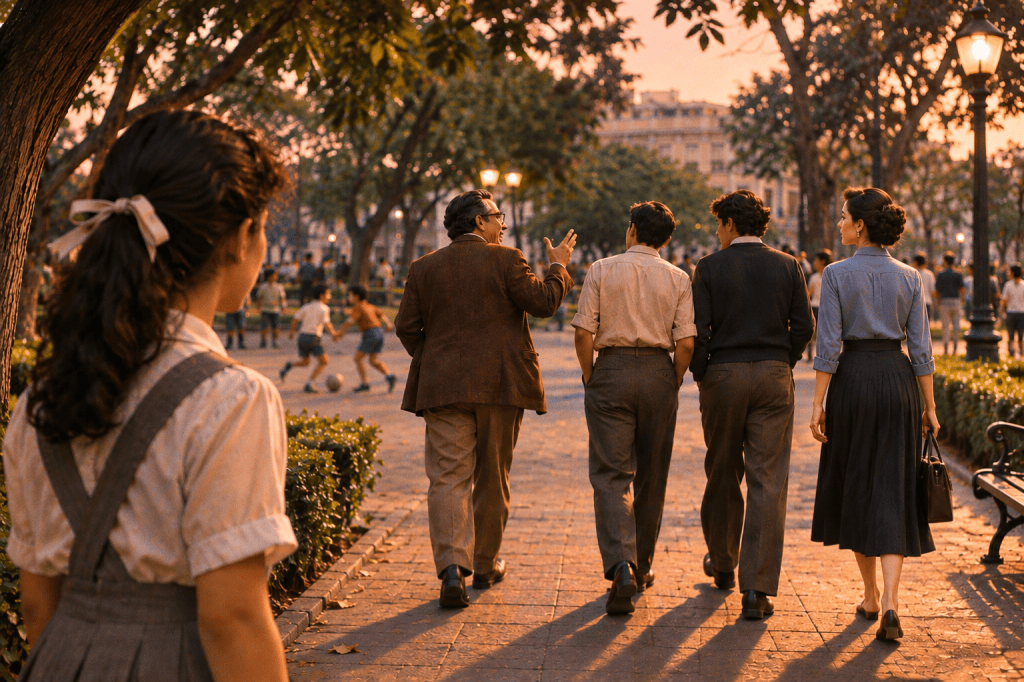
It was late afternoon, almost dusk, when we walked across a busy park.
There were children everywhere. It was loud, a little breezy, and I was embarrassed to still be wearing that dreadful school uniform, the gray skirt with suspenders over a white blouse.
I can still picture Father walking ahead, gesturing wildly as he spoke, while I trailed behind Julia and the others.
Four adults, and I was the only minor.
But I remember watching Father.
I just knew I’d be okay.
I don’t know how he managed it. Perhaps he’d spotted an advertisement in the newspaper or contacted someone he knew. Father was certainly never short of acquaintances.
Later that night, Julia told me we finally had a room.
It was in a large house on Fanning Street, within walking distance of Porta Street. The entire house, owned by an elderly Chilean woman, was rented out by the room. She kept one for herself in the basement.
By the time we arrived, it was late at night.
I followed her up a flight of ugly white cement steps leading from the second floor to the rooftop, which passed for a third floor.
A single dim light bulb illuminated the area.
We practically had to feel our way up, carrying what little we had.
Third door on the right.
On the rooftop. No one had mentioned that detail.
There was an double bed, at least, not just a mattress, a tiny closet built into a narrow space by the door, and a light bulb.
After the events of that afternoon, having somewhere to sleep was enough.
The room was meant for Julia and me, although she occasionally allowed Apophis to sleep there. He’d squeeze himself onto the floor between the bed and the little closet.
Father never came up.
Neither did Estuardo.
I don’t think I even knew where they were.
I continued attending the school Julia had enrolled me in, even after we moved to the rooftop room.
Frankly, I didn’t mind.
The day after we arrived, I discovered that our new accommodations came with some rather peculiar neighbors.
Someone next door had taken to drying animal horns in the sun.
He must have had quite a collection, because the horns changed regularly.
But the smell was constant.
In the third room was an older, slim, balding man who took an interest in Julia.
He even proposed marriage.
“Everything I own would be yours,” he told her.
She mocked him, insisted she was still a decent married woman and, from then on, avoided the man as much as she could.
The man was persistent, though, and tried to approach her a couple more times.
On one of my visits back to Porta, Cucha, on an aside, told me that one of my cats, Rayado, had been poisoned by a neighbor for stealing butter.
I said a few choice words about whoever had done it and changed the conversation.
Within minutes, I made up a story about having to leave.
I cried all the way back to the rooftop.
The visits to Porta stopped soon after.
The cats had never really belonged to me, of course. They’d been strays who wandered in and out of Father’s room, accepting whatever food and attention we could offer.
But I’d considered them mine.
When I think about those years I remember the beach nearby, the courtyard, Cucha and her gossip, and the assorted characters who lived around us.
I remember Father’s cooking, his stories about the farm, and that ridiculous bull named Clavelito.
I remember the rooftop room, the cold water, and those terrible-smelling horns.
And I can still see our belongings outside 750 Porta Street.
The mattress. My dictionaries.
But something has occurred to me only now, as I write this.
750 Porta was the last place I ever lived with Father.
Afterward, I didn’t even know where he lived.
I don’t remember seeing him again, except perhaps once or twice in passing, from a distance.
I made no attempt to see him, either.
I’d somehow appointed myself Julia’s defender in a conflict that belonged to the two of them.
I spoke disrespectfully of Father, sometimes treating him with outright disdain. It was my way of showing Julia that I was on her side.
As though loyalty to one parent required turning against the other.
I had listened to Julia’s version of their story, didn’t even think of her own responsibility towards me.
I was sixteen.
It occurs to me that the afternoon we walked across that park may well have been the last time I really saw him.
I remember him walking ahead, gesturing as he spoke.
And I remember looking at him–I knew I’d be fine.


