
She has the considerable advantage of knowing how everything turned out, then sits there wondering how anyone could have been so spectacularly careless.
I look back at the young woman I once was and sometimes wonder what the hell she thought she was doing.
She never gave it much thought herself.
I started drinking in my late teenage years. I had my first real job, and eventually began going out with coworkers after hours. I was flattered to be included, and looked forward to those evenings.
I thought I was the shit.
There I was, walking into a bar with a group of working adults, feeling terribly sophisticated.
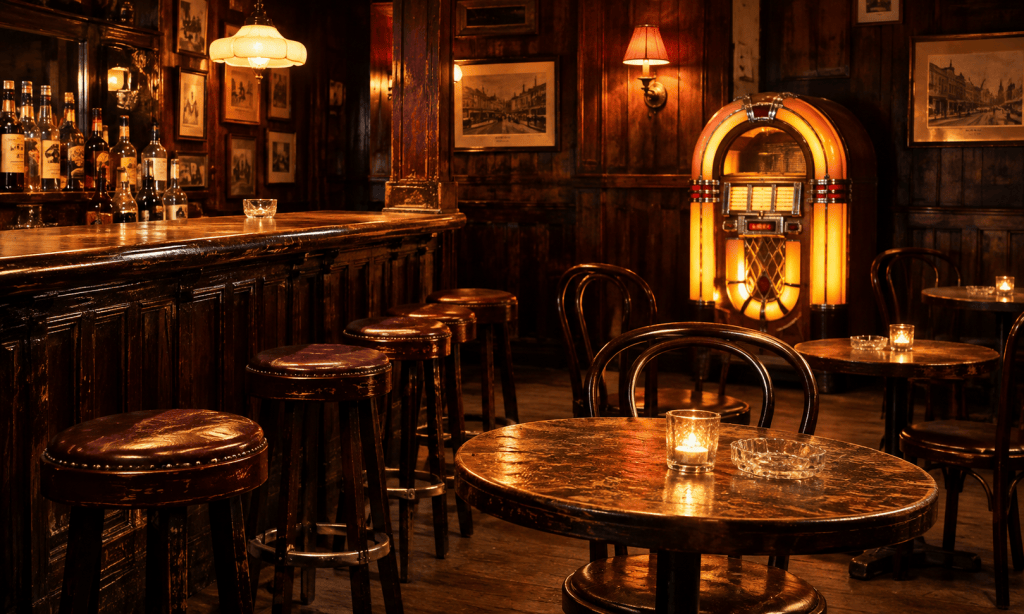
The place itself was nothing special. An old bar, the smell of beer and old wood, a jukebox playing somewhere. We’d sit at a table, have a few drinks, and carry on as though we were celebrities.
The conversations were amusing. The company pleasant.
Then again, after a couple of martinis, everybody’s pleasant.
I loved the atmosphere. Still do, oddly enough. There’s something about an old bar that almost mesmerizes me, although I can no longer say precisely what it is.
At the time, alcohol gave me something I hadn’t known how to obtain otherwise. I could socialize. I could participate. I could be one of the group. And, perhaps more importantly, Julia, my mother and her dysfunctions faded away.
Alcohol worked.
That’s the part I think people sometimes overlook. Alcohol did something for me before it began taking things away.
Eventually, I reached a point where I could do very little without drinking first. But I didn’t recognize that transition while it was happening. Nor did I stop to consider how thoroughly alcohol had begun influencing my decisions.
I just went about my business.
Or whatever passed for business in those days.
By the early 1980s, I had become remarkably accomplished at making decisions without considering their consequences.
For instance, I agreed to marry a man from Pakistan so that he could obtain legal status.
Just like that.
It began during a cab ride back to the room I was renting. I was drunk, of course, and somewhere along the way the driver mentioned that a relative or friend of his was looking for someone to marry so he could obtain legal documents.
I had never met the man.
Apparently, that wasn’t much of an obstacle.
His name was Ali something or other.
We went to City Hall, sat with another couple, had photographs taken, and went through the motions.
I had no particular desire to have a relationship with him. He seemed pleasant enough, and apparently that was sufficient qualification for marriage.
In the brief time between City Hall and our eventual divorce, we went to a strip lounge on the East Side, where Ali worked, to share the news of our marriage.
One of his coworkers approached me carrying a small manila envelope.
Inside was a ten-dollar bill.
He explained that it was customary for them to offer a gift to newly married people.
His name was Manzur.
But back to Ali.
At some point, I telephoned Immigration and told them I had entered into a sham marriage.
I cannot recall what prompted that decision. Perhaps the whole business had finally caught up with me. I had never favored doing anything illegal, which makes my agreeing to the marriage in the first place all the more inexplicable.
I was instructed to come in, so I took a train downtown.
If memory serves, the office was on the ninth floor. I spoke with a woman through a window and gave her Ali’s name.
Whether she took me seriously, I couldn’t say. I sometimes wonder if my appearance had anything to do with it. I was hardly a model of respectable presentation in those days.
But I remember feeling glad that I’d followed through. First the telephone call, then the trip downtown. I felt as though I was finally owning up to something I’d done wrong.
And yet, I didn’t tell Ali what I’d done.
Nor did I tell Manzur.
That strikes me as cheap and underhanded now. At the time, I barely gave it a thought.
If a fleeting thought of guilt crossed my mind, I probably dismissed it immediately, preferably into a shot of whisky.
About a month later, Ali told me, almost apologetically, that he thought it would be better for us to divorce.
I didn’t ask why.
In fact, despite my enthusiasm about going to Immigration, it had never even occurred to me to consider how I was going to divorce the man.
Ali took care of that, too.
He found and paid for a cheap lawyer, and within days we were sitting in some obscure law office, where I was asked to make up a reason for the breakup.
And that was that.
The divorce decree arrived in the mail.
We never saw each other again.
As for Manzur, the man with the ten-dollar wedding gift, it was with him that I eventually shared an apartment for approximately three years.
He was good to me.
He cooked for both of us, brought me alcohol he’d collected from several bottles, and we enjoyed one another’s company. We had animated conversations, and although ours was supposedly a relationship, physical intimacy was never something he imposed on me.
About halfway through our relationship, Manzur asked whether I’d ever consider going to his native country with him to be his second wife.
I had no clue what that meant.
I remember looking at him, perplexed, but I no longer recall what I said.
I don’t recall being particularly unhappy living with Manzur.
Quite the contrary, he treated me kindly.
Had it not been for that cab ride, I might never have met him. And without Manzur, I sometimes wonder where I would have ended up. Living on the streets was not beyond the realm of possibility.
Nevertheless, at some point, I decided to move on.
I’d gotten a job and become friendly with a couple of coworkers. We went out drinking, stayed late, and had ourselves a grand old time. I was in my mid-twenties, and this seemed a far more exciting prospect than the relatively quiet life I had with Manzur.
I might have told myself I wanted independence.
Another fellow, Joseph, had suggested we share expenses. It sounded like a sensible arrangement.
Of course, I was leaving one shared living arrangement for another, so precisely what I meant by independence is anybody’s guess.
What I wanted was the freedom to have fun, with little thought beyond where the next drink would come from.
Manzur went away on a trip to his country.
While he was gone, I gathered my few belongings and left with Joseph.
No great deliberation. No prolonged farewell. I simply decided I was leaving, and I did.
There was also Sally.
Sally was a black-and-white cat who had somehow come into my life while I was living with Manzur. He’d been kind enough to let me keep her.
I intended to take her along.
And here is where I find myself staring at the young woman I was in disbelief.
I wrapped Sally in a blanket, picked up her food bowl, and walked out.
A blanket.
It apparently never occurred to me that a frightened cat might struggle, escape, or require something more secure than a piece of cloth.
Joseph and I were crossing the street when Sally got loose.
She ran.
I couldn’t catch her.
And instead of searching for her, I became angry, threw her bowl aside, and continued walking.
That’s it.
I walked away.
I didn’t go back to look for her. I never mentioned the incident again.
In fact, the memory resurfaced only a handful of years ago.
Even now, I find it almost impossible to reconcile that young woman’s behavior with the person I’ve become.
It isn’t only that Sally escaped. Accidents happen.
It’s that I gave no thought to how I would carry her safely in the first place. And when something went wrong, I continued on my way as though nothing had happened.
How does someone do that?
I wish I had an answer.
I suspect alcohol had a great deal to do with it. By then, drinking had become the central occupation of my life. I could scarcely imagine going anywhere or doing anything without having consumed alcohol first.
But that doesn’t explain everything.
It doesn’t explain why I was so careless with people who treated me kindly. Why I moved from one situation to another without considering whether I was making a sensible choice. Why I seemed unable, or unwilling, to stop and examine what my life had become.
Sometimes I think I was almost anesthetized.
Not entirely without feeling, perhaps, but unwilling to examine whatever feelings were there.
And there were people who saw what was happening.
Julia certainly did.
She commented on my circumstances to others. She recognized that something was terribly wrong, yet never asked what help I might need, let alone offered any.
I still resent that.
But I also know that resentment cannot account for every decision I made.
And this is where hindsight becomes particularly insufferable.
She knows what became of the teenager who was delighted to be invited out with coworkers. She knows how those evenings of drinking and feeling independent eventually gave way to a life in which alcohol influenced nearly everything.
And she knows how much might’ve been different.
I sometimes wonder who I might have become had I never started drinking.
But there’s no answer to that question. There is only the life I actually lived.
I don’t wish to pretend those early evenings at the bar were miserable. They weren’t.
I enjoyed myself, for the most part.
I liked the people, the conversations, the jukebox, the smell of beer and old wood. I liked feeling grown-up, being included, having somewhere to go after work.
Alcohol made those things possible for me.
It worked.
Until it didn’t.
What I struggle to understand is the young woman who moved through so much of her life without seeming to recognize that she mattered, that her decisions mattered, and that other people—and animals—could be affected by them.
I feel sadness for her.
I feel anger, too.
For Christ’s sake, girl, couldn’t you have stopped and thought about what you were doing? Just once?
That, of course, is hindsight talking.
The smug old bitch knows everything that happened afterward.
And even with all that knowledge, there are things she still cannot explain.


